
Table of Contents
High Pressure Processing (HPP) has become an increasingly important non-thermal processing technology for food manufacturers seeking to improve food safety while maintaining freshness, nutritional value, and sensory quality. One of the most common questions surrounding HPP is whether exposing food to extremely high pressure causes protein degradation.
The short answer is: HPP does not generally cause the extensive protein degradation associated with conventional high-temperature sterilization. Instead, high pressure primarily changes the physical structure and conformation of proteins. Depending on the food matrix, pressure level, holding time, temperature, and protein type, these structural changes can be reversible or irreversible and may affect texture, solubility, functionality, and digestibility.
Understanding the difference between protein degradation and protein structural modification is essential when evaluating HPP as a food processing technology.
What Is HPP Sterilization?
HPP Sterilization, more accurately described in many food applications as High Pressure Processing, uses hydrostatic pressure rather than high temperatures as the primary processing mechanism.
During HPP, packaged food is placed inside a high pressure vessel filled with water. The system then rapidly increases pressure, commonly within the range of approximately 300–600 MPa, depending on the product and processing objective.
Because pressure is transmitted uniformly through the water and the food, HPP can process products relatively evenly regardless of their shape or size.
Unlike conventional thermal processing, HPP can reduce microorganisms while minimizing the exposure of food to prolonged high temperatures. This makes it particularly attractive for products where manufacturers want to maintain fresh flavor, color, nutrients, and other quality attributes.
Modern high pressure processing equipment is therefore increasingly used for products such as:
- Ready-to-eat meals
- Fruit and vegetable juices
- Smoothies and beverages
- Meat and seafood products
- Dairy products
- Baby food
- Pet food
- Sauces and dips
Does High Pressure Processing Destroy Protein?
Generally, no.
High pressure does not typically break protein molecules into small fragments in the same way that chemical hydrolysis or certain severe thermal conditions can. Instead, pressure mainly affects the non-covalent interactions that maintain a protein’s three-dimensional structure.
Protein structure is commonly described at four levels:
- Primary structure – the amino acid sequence
- Secondary structure – structures such as α-helices and β-sheets
- Tertiary structure – the overall three-dimensional folding of a protein
- Quaternary structure – the arrangement of multiple protein subunits
HPP can alter secondary, tertiary, and quaternary structures while generally preserving the primary amino acid sequence.
This distinction is important.
A protein can become denatured without being chemically degraded. In other words, its shape may change while the amino acid composition and nutritional protein content remain substantially intact.
Protein Denaturation vs. Protein Degradation
These two concepts should not be treated as identical.
Protein denaturation refers primarily to changes in the protein’s spatial structure. The protein may unfold, aggregate, or reorganize because pressure disrupts certain non-covalent interactions.
Protein degradation, on the other hand, generally refers to the breakdown of the protein molecule itself, such as cleavage of peptide bonds.
Under properly controlled HPP conditions, the major effect on many food proteins is structural modification rather than extensive breakdown of the peptide backbone.
How Does Pressure Affect Protein Structure?
The effects of HPP are closely related to the molecular interactions responsible for maintaining protein structure.
High pressure can influence:
- Hydrophobic interactions
- Electrostatic interactions
- Hydrogen bonding
- Protein-water interactions
- Protein-protein interactions
Pressure can promote structural rearrangements as proteins move toward configurations with different molecular volumes.
This can result in partial or complete unfolding, followed by aggregation or other structural changes.
For example, when a globular protein unfolds under pressure, previously buried regions of the molecule may become exposed. These exposed regions can interact with other proteins, potentially producing aggregation.
This phenomenon can be useful in some applications.
For example, controlled protein modification may contribute to changes in:
- Gel formation
- Texture
- Water-holding capacity
- Emulsification
- Foaming properties
- Protein solubility
- Digestibility
Does HPP Reduce the Nutritional Value of Protein?
For most food applications, HPP is considered a relatively gentle technology from a nutritional perspective because it avoids the prolonged high temperatures associated with conventional thermal processing.
The amino acid sequence of proteins is generally much more resistant to pressure than their higher-order structures.
Consequently, pressure-induced denaturation does not necessarily mean nutritional protein loss.
In practical terms, a food can contain proteins that have undergone structural changes while still providing substantial nutritional protein.
This is one reason HPP is attractive for products where manufacturers want to balance microbial safety with nutritional and sensory quality.
However, nutritional outcomes depend on the complete processing system. Product formulation, pressure, temperature, holding time, raw materials, packaging, and subsequent storage conditions can all influence the final product.
Therefore, manufacturers should validate the actual nutritional performance of each product rather than assuming that every food behaves identically under HPP.
HPP vs. Thermal Processing: What Happens to Protein?
One of the major advantages of HPP is that it can achieve microbial inactivation with significantly less reliance on heat.
Traditional thermal processing exposes food to elevated temperatures for a defined period. Heat can cause a range of chemical and physical reactions, including protein denaturation, aggregation, Maillard reactions, and changes in flavor and color.
HPP follows a different mechanism.
| Comparison Item | HPP High Pressure Processing | Conventional Thermal Processing |
|---|---|---|
| Primary Target | Non-covalent bonds (hydrogen bonds and hydrophobic interactions) | Both covalent and non-covalent bonds |
| Effect on Proteins | Alters the tertiary structure (denaturation) while preserving peptide bonds | May cause peptide bond cleavage and Maillard reactions |
| Amino Acid Loss | Minimal to negligible | Significant loss of heat-sensitive amino acids, such as lysine |
| Nutrient Retention | Protein retention rate >90% | Higher degree of protein denaturation and potential nutrient loss |
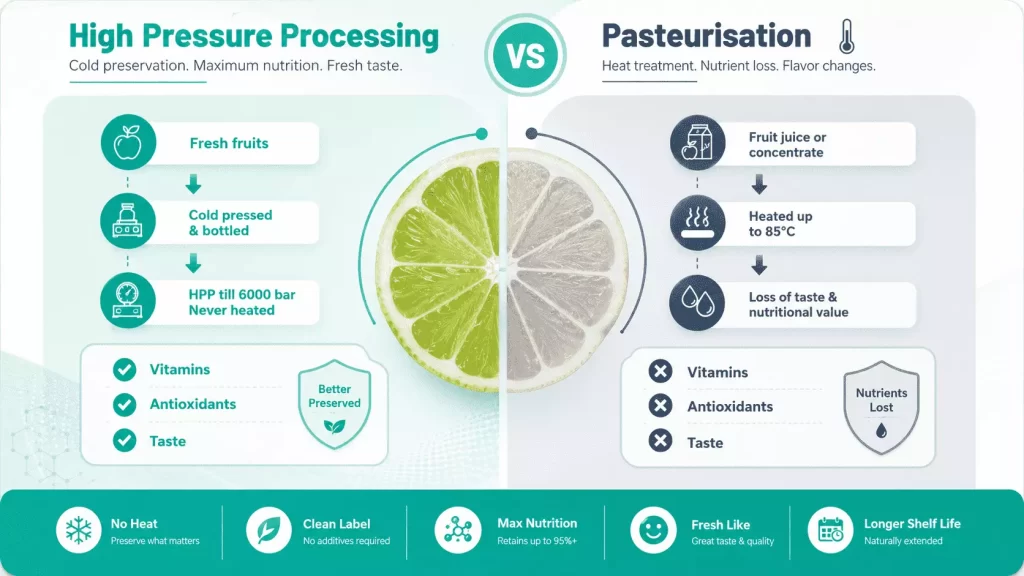
Key Conclusion: HPP denatures proteins by changing their structure, but does not degrade them because the peptide bonds remain intact. As a result, the nutritional value of proteins, including their amino acid composition, is largely preserved.
Positive Effects of HPP on Proteins
Texture Optimization: HPP can induce protein gelation, improving the texture and structural properties of meat and soy-based products without the need for chemical texture modifiers.
Improved Digestibility: Moderate pressure-induced denaturation can unfold protein structures and expose enzymatic cleavage sites, potentially increasing the accessibility of digestive enzymes and supporting nutrient absorption.
Preserved Functionality: For heat-sensitive proteins such as whey proteins and immunoglobulins in dairy products, HPP can help preserve their functional structures and minimize the loss of activity associated with thermal denaturation.
What Factors Determine Protein Changes During HPP?
The impact of high pressure on proteins depends on several processing parameters.
1. Pressure Level
Higher pressure generally produces stronger structural effects.
A mild pressure treatment may cause limited protein modification, whereas a higher-pressure process can induce more extensive unfolding or aggregation.
However, simply increasing pressure does not automatically produce a better product. The optimal pressure depends on the target microorganisms and desired product characteristics.
2. Holding Time
Pressure intensity and holding time work together.
A shorter treatment at higher pressure may produce a different protein response from a longer treatment at lower pressure.
HPP process development therefore needs to consider pressure-time combinations rather than evaluating pressure alone.
3. Temperature
Temperature can significantly influence protein behavior during HPP.
HPP performed near refrigerated or ambient conditions can produce different protein changes from pressure treatment combined with elevated temperatures.
For food manufacturers, controlling temperature throughout the process is therefore an important part of achieving consistent results.
4. Protein Type
Not all proteins respond to pressure in the same way.
Proteins from:
- Milk
- Meat
- Eggs
- Legumes
- Cereals
- Seafood
can exhibit different pressure sensitivities because their molecular structures and interactions are different.
5. Food Matrix
Proteins do not exist in isolation in most foods.
pH, salt concentration, sugars, fats, minerals, moisture content, and other ingredients can influence pressure-induced protein changes.
For example, a protein in a beverage matrix may behave differently from the same protein in a meat or dairy system.
Why HPP Is Attractive for High-Protein Foods
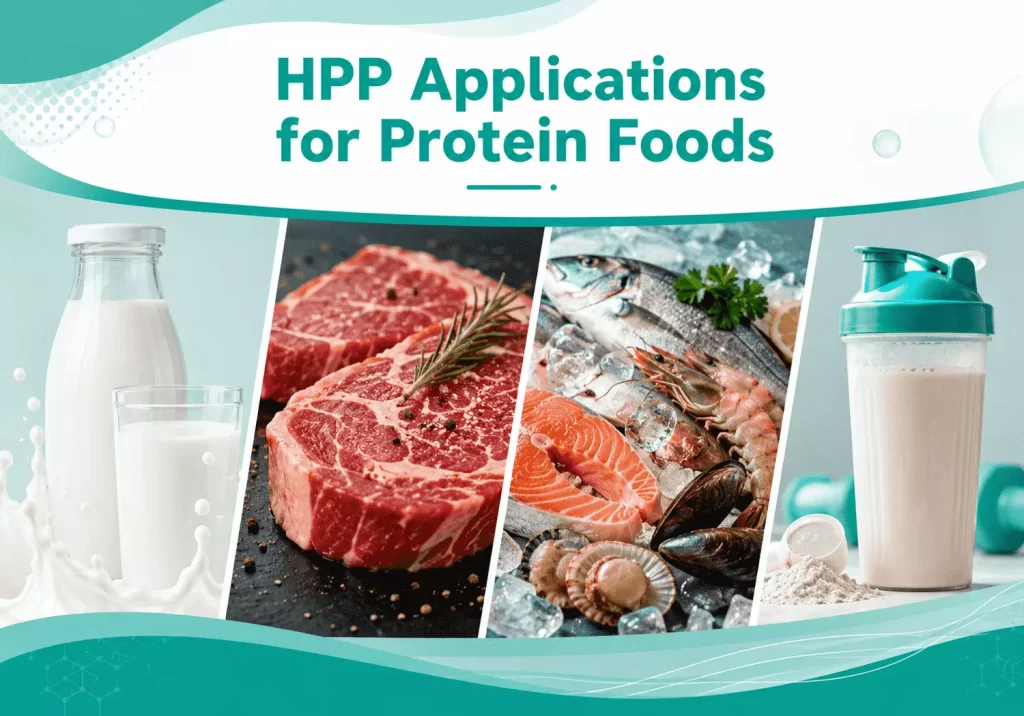
The ability to reduce microbial risks while limiting severe thermal exposure makes HPP particularly interesting for high-protein food products.
Potential applications include:
Dairy Products
HPP can be investigated for milk-based products, yogurt, cheese, and other dairy formulations where manufacturers want to control microorganisms while maintaining desirable nutritional and sensory properties.
Meat and Seafood
Pressure processing can affect myofibrillar proteins and connective tissue proteins, which may influence tenderness, water retention, and texture.
This makes process optimization especially important for meat and seafood applications.
Plant-Based Foods
Plant proteins can have challenges related to solubility, flavor, texture, and functionality.
HPP may modify protein structures and therefore influence the texture and functional properties of plant-based formulations.
Protein-Rich Beverages
For protein beverages and functional drinks, maintaining protein dispersion and preventing undesirable aggregation are key considerations.
A properly developed HPP process can help manufacturers evaluate microbial stability while managing changes in protein functionality.
Why Choose HiLock HPP Equipment for Protein-Rich Foods?
For protein-rich foods, achieving effective microbial control while maintaining nutritional value, protein functionality, and product quality requires precise control over the processing conditions. HiLock HPP equipment combines advanced pressure-control technology, low-temperature processing, robust high-pressure vessel design, and extensive process-development experience to help food manufacturers achieve consistent and reliable results. Key advantages include:
Database of 1,000+ Food Processing Recipes: Based on the characteristics of different food materials—including dairy products, meat products, and plant proteins—HiLock provides customized pressure-time parameter matching to precisely control the degree of protein denaturation and achieve an optimal balance between nutritional retention and texture optimization.
Precise Pressure Control for Protein Protection: HiLock uses a high-precision intelligent pressure control system with an accuracy of ±5 MPa, ensuring uniform pressure distribution throughout the product and minimizing the risk of localized overpressure and excessive protein denaturation. Protein retention can exceed 90% under appropriate processing conditions.
Cold Processing at Near-Ambient Temperatures: Processing temperatures can be controlled within 5–25°C, helping minimize heat-induced protein degradation, Maillard reactions, and the loss of heat-sensitive amino acids while preserving the food’s natural nutrients and flavor.
Aerospace-Grade High-Pressure Vessel for Reliable Processing: The high-pressure vessel is manufactured from aerospace-grade 15-5 stainless steel forgings and is designed for a service life of up to 200,000 cycles, helping maintain pressure consistency between batches and ensuring stable protein-processing results.
Conclusion
So, does the protein in food degrade after HPP sterilization?
In most properly controlled HPP applications, the answer is not in the conventional sense of extensive protein breakdown.
High pressure processing primarily affects the physical structure of proteins. It can cause unfolding, denaturation, aggregation, and changes in functionality while generally preserving the underlying amino acid sequence.
This makes high pressure processing an attractive technology for food manufacturers seeking microbial control while maintaining nutritional and sensory characteristics.
However, HPP is not a one-size-fits-all technology. Pressure, time, temperature, formulation, protein type, packaging, and storage conditions all influence the final result.
For manufacturers developing HPP products, selecting the right high pressure processing equipment and working with an experienced engineering partner are essential for achieving repeatable processing conditions and consistent product quality.
With capabilities covering ultra-high-pressure equipment R&D, precision manufacturing, customized non-standard equipment, process development, installation, testing, and full-lifecycle maintenance, an integrated HPP solution can provide a practical pathway from laboratory trials to commercial-scale production.
If you are evaluating HPP for protein-rich foods, beverages, dairy products, meat, plant-based products, or other applications, the most effective approach is to develop and validate the process around your specific product rather than relying on a generic pressure setting.