
Table of Contents
Solid-state batteries are widely regarded as one of the most promising next-generation battery technologies because they replace conventional liquid electrolytes with solid electrolytes. This architecture has the potential to improve safety, increase energy density, and enable new cell designs.
However, the biggest challenge facing the industry is no longer simply proving that solid-state battery materials work in the laboratory. The more difficult question is how to manufacture these materials and integrate them into reliable battery cells at industrial scale.
The industry is now moving from laboratory research toward pilot production and engineering validation. TrendForce reported that more than 57 solid-state battery financing deals were completed globally between 2025 and the first quarter of 2026, involving more than US$1.3 billion in disclosed funding. The report also identified 2025–2026 as a critical period for moving solid-state battery technology toward pre-commercialization.
At the same time, TrendForce estimates that nearly 100 companies worldwide have announced solid-state battery production plans, with combined planned capacity exceeding 100 GWh. However, much of the current large-scale production is still concentrated in semi-solid batteries, while all-solid-state batteries remain largely in pilot-production and validation stages.
This transition creates a new priority for battery manufacturers:
How can solid-state battery materials be processed with the consistency, density, and scalability required for mass production?
One technology attracting increasing attention is warm isostatic pressing.
Three Major Bottlenecks Facing Solid-State Battery Mass Production
Despite their significant advantages, solid-state batteries still face multiple challenges in moving from laboratory development to large-scale mass production. The key bottlenecks include the following:
- Solid-solid interface contact: Unlike the naturally wetted “solid-liquid” contact in conventional liquid batteries, both the electrodes and electrolyte in solid-state batteries are rigid solids, resulting in “hard-to-hard” point contact. Microscopic gaps can easily form between layers, causing interfacial impedance to increase dramatically during cycling.
- Densification process bottleneck: Traditional roll pressing (≤250 MPa, two-dimensional pressing) and hot pressing (≤200 MPa, unidirectional pressing) have limited pressure capabilities and cannot provide uniform pressure distribution. This can lead to density gradients and even electrode damage. Porosity can typically only be reduced to around 7%–10%, which remains well above the <5% target required for mass production.
- Cell consistency and yield: For large-format cells, it is difficult to ensure uniform pressure distribution during pressing. Differences in density between layers and across production batches can lead to significant performance variations, making it difficult to improve mass-production yield.
These challenges ultimately converge on one critical manufacturing step: densification pressing.
Whether a cell can achieve uniform three-dimensional high-pressure densification across its entire volume directly affects interfacial impedance, cycle life, and mass-production yield.
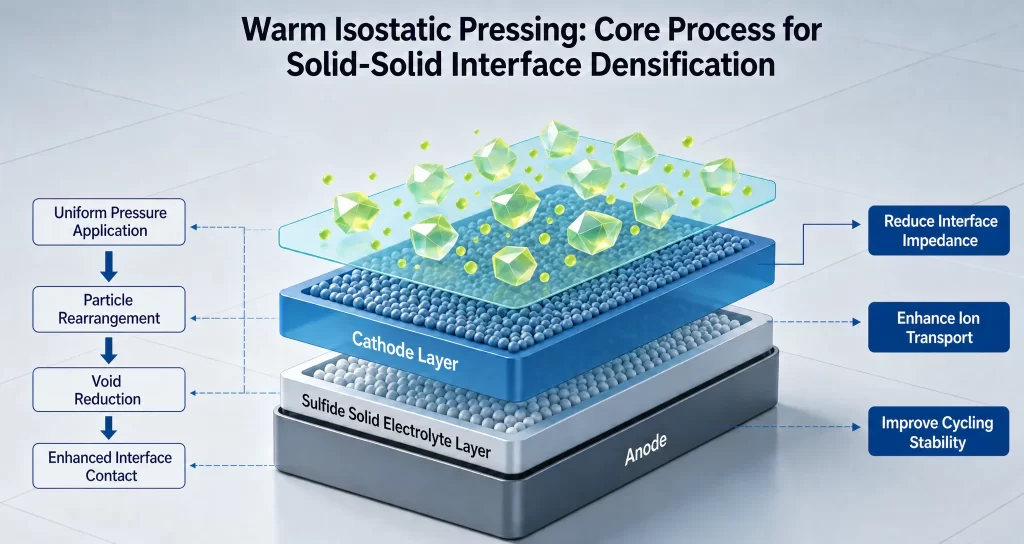
Warm Isostatic Pressing: A Key Technology for Solving Solid-State Battery Interface Challenges
What Is Warm Isostatic Pressing?
Warm Isostatic Pressing (WIP) uses a liquid or gas as the pressure-transmitting medium to apply uniform hydrostatic pressure from all directions to a cell.
This enables every electrode layer and interface within the cell to experience highly uniform compression, effectively eliminating microscopic voids, increasing the effective contact area, and significantly reducing interfacial impedance.
At the same time, precise temperature-field control can promote the plastic flow of electrolyte particles and facilitate interfacial bonding, further increasing material density toward its theoretical value.
With optimized process parameters, porosity can be consistently controlled below 5%, helping meet the manufacturing requirements of all-solid-state batteries.
Core Technical Advantages of Warm Isostatic Pressing
1. Improved Solid-Solid Interface Contact
Under ultra-high pressures of 300–600 MPa, the interfacial contact between solid electrolytes and electrode materials can be significantly improved.
Because pressure is uniformly transmitted through the pressure medium in all directions, microscopic pores and gaps at the interface can be reduced, maximizing the effective solid-solid contact area and substantially lowering interfacial impedance.
2. Efficiently Breaking Up Inorganic Filler Agglomeration
During ultra-high-pressure processing, materials can experience intense shear forces, impact forces, and cavitation effects within microchannels, enabling the efficient breakdown of inorganic filler agglomerates.
Experimental data indicate that after ultra-high-pressure homogenization, the particle size of inorganic fillers in solid-state electrolytes can be reduced from an initial 74 μm to below 360 nm, while the PDI decreases from 0.41 to 0.27, representing an approximately 34.1% improvement in dispersion uniformity.
3. Improved Ionic Conductivity
By optimizing filler dispersion and interfacial contact, the ionic conductivity of solid-state electrolytes can increase from 1.2 × 10⁻⁴ S/cm using conventional methods to 8.5 × 10⁻⁴ S/cm, representing an improvement of more than six times.
The resulting reduction in interfacial resistance provides reliable support for high-performance solid-state battery operation.
4. Improved Batch-to-Batch Consistency
Warm isostatic pressing uses a purely physical processing method, with no solvent residues or chemical additives, while allowing precise control of key process parameters.
After processing, product consistency across different batches can reach more than 98.5%, helping meet the requirements of large-scale industrial production.
HiLock: Professional Warm Isostatic Pressing Solutions
To address the interface-contact and filler-dispersion challenges associated with solid-state battery mass production, HiLock provides customized warm isostatic pressing solutions.
HiLock combines in-house developed core components, a comprehensive product portfolio, and full-process technical support to help new-energy companies overcome solid-state battery manufacturing bottlenecks and accelerate the commercialization of next-generation battery technologies.
Core Components Developed In-House
HiLock independently designs and manufactures its high-pressure vessels, pressurization systems, and intelligent pressure-control systems, supported by thousands of process tests and validations.
This approach helps ensure consistent equipment performance, shorten delivery cycles, and reduce operation and maintenance costs.
Precise Temperature-Pressure Coordinated Control
HiLock’s proprietary temperature-pressure coordination system supports a pressure range of up to 600 MPa, with flexible pressure adjustment for different operating conditions.
Pressure fluctuations can be controlled within ±1 MPa.
The system supports a temperature range of 80–150°C and integrates PLC-based automated control. Temperature fluctuations inside the pressure chamber can be controlled within ±3°C.
The equipment is compatible with major solid-electrolyte systems, including sulfide-, oxide-, and polymer-based electrolytes.
Full Closed-Loop Testing and Validation
HiLock operates dedicated ultra-high-pressure assembly facilities and testing laboratories.
Before shipment, each piece of equipment undergoes comprehensive pressure-cycle testing, temperature-control accuracy testing, and reliability evaluation, establishing a closed-loop quality system covering:
Design → Manufacturing → Testing
This approach helps ensure equipment reliability and consistent performance in industrial applications.
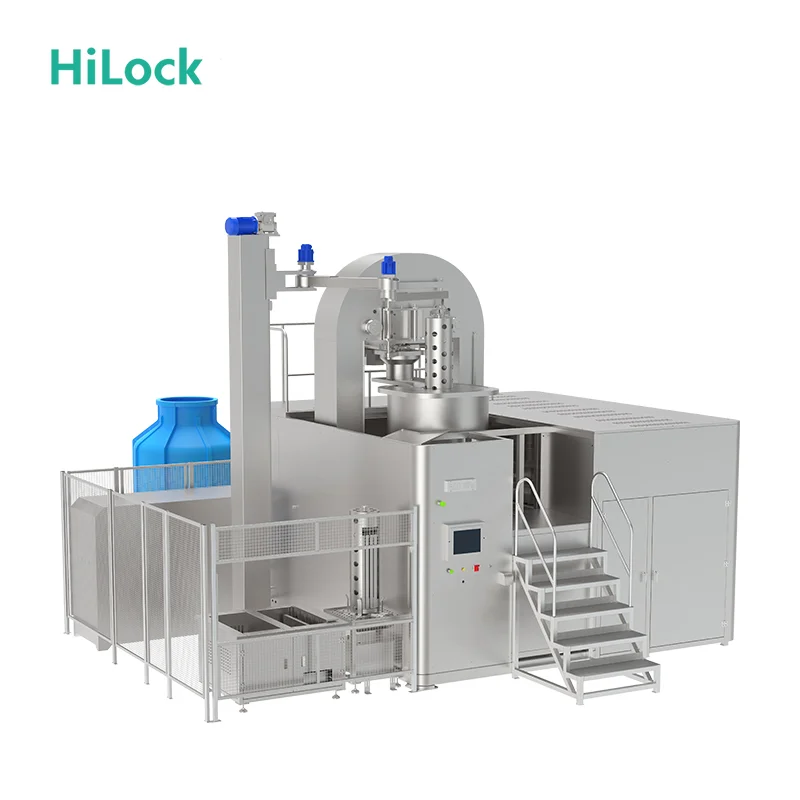
HiLock: An Integrated Solution for Solid-State Battery Industrialization
HiLock has established a vertical + horizontal dual-machine configuration, precisely addressing the requirements of solid-state battery development across the full production cycle—from R&D and pilot-scale testing to mass production.
Since 2026, HiLock’s vertical warm isostatic pressing systems have been delivered to leading new-energy companies and deployed in large-scale hybrid solid-liquid battery production lines, while also supporting the transition toward pilot production of all-solid-state batteries.
More importantly, HiLock provides more than equipment.
It delivers an integrated “Equipment + Process + Operation & Maintenance” solution.
Starting with the customer’s material formulation, HiLock develops customized operating parameters and provides technical support throughout the entire development process—from laboratory-scale trials and pilot validation to industrial-scale mass production.
By combining advanced warm isostatic pressing equipment with process development and technical support, HiLock aims to help new-energy companies overcome manufacturing bottlenecks and accelerate the commercialization of next-generation battery technologies.
From laboratory innovation to industrial-scale production, HiLock is committed to enabling the next generation of solid-state battery manufacturing.
Conclusion
The key to achieving mass production of solid-state batteries lies in overcoming two critical challenges: solid-solid interface contact and uniform filler dispersion. With its unique advantages of ultra-high pressure, isotropic pressure distribution, and precise temperature control, Warm Isostatic Pressing (WIP) provides a practical and scalable pathway toward the industrialization of solid-state batteries.
As a professional supplier of warm isostatic pressing technology, HiLock leverages in-house developed core components, a comprehensive product portfolio, and full-process technical support to help new-energy companies overcome solid-state battery mass-production bottlenecks and accelerate the commercialization of next-generation battery technologies.