
Table of Contents
Beef burgers are widely consumed as fresh, refrigerated, frozen, and ready-to-eat meat products. However, because they are made from ground beef, the grinding process can distribute microorganisms throughout the product rather than leaving contamination only on the surface. E. coli, Shiga toxin-producing E. coli (STEC), and Listeria monocytogenes are therefore important food-safety considerations for beef burger manufacturers.
Traditional thermal processing remains an important pathogen-control method, but food manufacturers are also exploring non-thermal technologies that can provide microbial reduction while supporting product quality and refrigerated distribution.
High pressure processing (HPP) is one such technology.
By applying hydrostatic pressure to packaged food, HPP can inactivate many vegetative microorganisms without relying on conventional high-temperature treatment. Research specifically conducted on beef burgers and ground beef has demonstrated significant reductions in STEC and Listeria monocytogenes under suitable pressure-time conditions.
For manufacturers, however, the key question is not simply whether HPP can kill bacteria. The more important question is:
How can high pressure processing be engineered, validated, and integrated into a commercial beef burger production process?
This article examines the science behind HPP for beef burgers, available research data, processing considerations, and the role of high pressure processing equipment in developing a reliable industrial solution.
Why Food Safety Is a Critical Challenge for Beef Burgers
Ground beef presents a different microbial-control challenge from intact muscle cuts.
During grinding and forming, microorganisms that may initially be present on the exterior of meat can become distributed throughout the ground product. This means that a contamination event is not necessarily limited to the surface of a burger patty.
For beef burgers, important microbiological hazards can include:
- Shiga toxin-producing E. coli (STEC)
- E. coli O157:H7
- Listeria monocytogenes
- Salmonella
- Spoilage microorganisms
The FDA’s food-safety materials identify enteric pathogens including verotoxigenic E. coli and Salmonella as significant biological hazards associated with beef patties and emphasize that an effective lethality process must be designed around the characteristics of the product and the microorganisms of concern.
For ready-to-eat meat products, Listeria monocytogenes presents an additional concern because it can grow under refrigerated conditions. USDA FSIS specifically identifies L. monocytogenes as a major concern for RTE meat and poultry products and recognizes post-lethality treatments as one approach to controlling the pathogen.
This creates an important opportunity for high pressure processing as part of a validated food-safety strategy.
How High Pressure Processing Works for Beef Burgers
High Pressure Processing (HPP) uses water as the pressure-transmitting medium. Packaged food is placed inside a pressure vessel, and hydrostatic pressure is transmitted uniformly throughout the product.
Unlike conventional thermal processing, HPP can achieve microbial inactivation without relying on high temperatures. The effectiveness depends on pressure, holding time, temperature, food composition, target microorganism and other process conditions. [5][7]
For beef burgers, HPP can disrupt microbial cell membranes and affect proteins and other cellular structures, helping reduce vegetative pathogens such as E. coli and Listeria monocytogenes. [5][6]
Research: Can HPP Control E. coli in Beef Burgers?
One of the most relevant studies for this application investigated HPP treatment of raw ground beef patties inoculated with multiple STEC strains.
The researchers evaluated:
- 350 MPa
- 450 MPa
- 600 MPa
- 5-minute treatment time
- approximately 10°C treatment temperature
The study evaluated several STEC strains, including O157:H7, O26, O45, O103, O111, O121 and O145.
The results were significant.
At 600 MPa for 5 minutes, approximately 5-log CFU/g reductions were obtained for all of the STEC strains tested from an initial inoculation level of approximately 6 log CFU/g. The researchers concluded that 600 MPa HPP could be considered a valid non-thermal technology for achieving approximately 5-log reductions under the conditions investigated. [1]
Research data: HPP and STEC in raw beef patties
| HPP condition | Observed STEC reduction |
|---|---|
| 350 MPa, 5 min | Lower reduction; strain-dependent |
| 450 MPa, 5 min | Approximately 1.6–>5 log CFU/g depending on strain |
| 600 MPa, 5 min | Approximately 5 log CFU/g for tested STEC strains |
Source: Martínez Bernié et al., LWT – Food Science and Technology, 2021. DOI: 10.1016/j.lwt.2021.112126.
The study also found that pressure resistance differed between strains. This is an important point for industrial applications:
There is no universal HPP parameter that should be assumed to work identically for every beef burger product or every microbial hazard.
Actual pressure, holding time, temperature, initial microbial load, product formulation, fat content, packaging, storage conditions, and target reduction must be considered during process development and validation.
HPP and Listeria monocytogenes in Beef Burgers
Listeria monocytogenes is particularly relevant to refrigerated and ready-to-eat meat products.
A study published in the Journal of Food Protection directly evaluated HPP against both STEC and L. monocytogenes in beef and plant-based burgers.
The researchers tested refrigerated samples at 4°C under pressures of 350 and 600 MPa.
At 600 MPa for up to 4.5 minutes, refrigerated beef and plant-based burger samples showed reductions of approximately:
- 0.7–4.1 log CFU/g for STEC
- 0.3–5.6 log CFU/g for L. monocytogenes
The study also found that pathogen resistance varied according to both the microorganism and the food matrix.
This finding is particularly valuable for food manufacturers because it demonstrates that HPP performance cannot be evaluated independently of the product itself. [2]
Why does the food matrix matter?
The same pressure does not necessarily produce the same microbial reduction in every food.
Factors can include:
- Fat content
- Protein composition
- Water activity
- pH
- Salt concentration
- Formulation
- Initial temperature
- Initial microbial population
- Packaging
- Pressure-holding time
Consequently, an HPP process designed for one meat product should not automatically be transferred to another product without validation.
Does HPP Sterilize Beef Burgers?
No—not in the conventional sense of commercial sterilization.
This distinction is important for both manufacturers and consumers.
HPP is highly effective against many vegetative bacteria, including important foodborne pathogens. However, bacterial spores are substantially more resistant to pressure. [5][7]
Therefore, it is more technically accurate to describe HPP as a:
- Non-thermal microbial inactivation technology
- Pasteurization technology in appropriate applications
- Pathogen-reduction intervention
- Post-lethality treatment
- Shelf-life extension technology
rather than simply calling it a “sterilization” process.
For example, CFIA guidance states that HPP treatments used to control biological hazards require validation and notes that typical commercial HPP treatments commonly use up to 600 MPa, with actual treatment parameters needing validation when food safety is involved.
This distinction should also be reflected in technical marketing.
For an overseas B2B website, “HPP pathogen reduction”, “HPP pasteurization”, or “HPP food safety” is generally more scientifically precise than claiming that HPP completely sterilizes every beef burger. [5][6]
Typical HPP Parameters for Beef Burgers
Research on beef burgers has investigated pressures from approximately 350 to 600 MPa, with several studies reporting particularly strong microbial reductions at 600 MPa.
A representative research range can therefore be summarized as:
| Parameter | Research/application range |
|---|---|
| Pressure | 350–600 MPa |
| Higher-pressure research point | 600 MPa |
| Holding time | Approximately 3–12+ min depending on study |
| Product temperature | Refrigerated / mild-temperature conditions in many studies |
| Packaging | Flexible or semi-flexible packages generally required |
| Target organisms | STEC, E. coli O157:H7, Listeria monocytogenes and others |
| Process objective | Pathogen reduction, post-lethality treatment, shelf-life extension |
Source: [1][2][3][5]
Important: These values are research/application references, not a universal processing recipe for commercial beef burgers.
The final HPP schedule should be established through product-specific challenge testing and process validation.
How High Pressure Processing Equipment Supports Burger Production
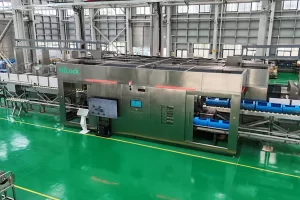
For industrial beef burger manufacturers, the performance of the high pressure processing equipment is critical.
An HPP system must do more than generate high pressure. It must provide stable, repeatable and controllable processing conditions.
Key equipment considerations include:
1. Pressure capability
Commercial HPP systems commonly operate at several hundred MPa, with 600 MPa being an important processing level in many food applications.
For beef burger applications, equipment should provide sufficient pressure capability for the validated process while maintaining stable pressure throughout the holding period.
2. Chamber volume
Production capacity depends heavily on chamber volume and cycle time.
Different manufacturers may require:
- Laboratory-scale systems for product development
- Pilot-scale systems for process validation
- Medium-scale systems for market testing
- Large industrial systems for continuous commercial production
3. Packaging compatibility
Because HPP transmits pressure through water, burger products normally need packaging capable of tolerating the pressure cycle.
Packaging selection should consider:
- Flexibility
- Seal strength
- Headspace
- Material structure
- Water resistance
- Product geometry
4. Pressure uniformity and repeatability
A commercial HPP process must consistently reproduce the validated pressure-time-temperature conditions.
Stable pressure control is therefore essential for both microbial safety and production consistency.
5. Automation and monitoring
Industrial HPP equipment can integrate:
- HMI controls
- Pressure monitoring
- Temperature monitoring
- Recipe management
- Process records
- Alarm systems
- Automated loading/unloading
These functions help manufacturers move from laboratory experiments to repeatable commercial processing.
Can HPP Extend the Shelf Life of Beef Burgers?
Yes, research indicates that HPP can contribute to microbial shelf-life extension in beef burgers and other meat products.
For example, a study examining HPP-treated beef burgers reported acceptable microbial quality after 60 days of chilled storage when burgers were treated at 600 MPa under the study conditions.
Another broader study on packed meat products found that HPP at 600 MPa for 5 minutes and 25°C could significantly extend refrigerated shelf life and control microbial growth under the investigated storage conditions.
However, shelf life is not determined by HPP pressure alone. [8]
It depends on:
HPP treatment + product formulation + initial microbial load + packaging + storage temperature + post-process handling
For this reason, manufacturers should conduct shelf-life studies under their intended commercial distribution conditions.
Conclusion: Why Consider High Pressure Processing for Beef Burgers?
Research has demonstrated that high pressure processing can significantly reduce important foodborne pathogens in beef burgers and ground beef, including STEC, E. coli O157:H7 and Listeria monocytogenes.
Among the published studies:
- 600 MPa for 5 minutes produced approximately 5-log CFU/g reductions across the tested STEC strains in one raw ground beef patty study.
- In another burger study, 600 MPa for up to 4.5 minutes produced reductions of up to approximately 4.1 log CFU/g for STEC and 5.6 log CFU/g for Listeria under the tested refrigerated conditions.
- A separate beef burger study identified 600 MPa for 5 minutes as its most lethal tested treatment against E. coli O157.
- Studies of other RTE meat products have also demonstrated substantial Listeria monocytogenes reductions and refrigerated shelf-life benefits after HPP.
These results demonstrate the potential of HPP—but they also demonstrate why product-specific validation matters.
For manufacturers looking to develop safer, longer-lasting refrigerated meat products, the next step is not simply selecting the highest pressure. It is determining the right combination of pressure, holding time, temperature, packaging, product formulation and storage conditions.
With the right high pressure processing equipment, laboratory testing, process development and engineering support, HPP can become a scalable component of a modern beef burger processing strategy.
References
[1] Martínez Bernié, I., et al. (2021). Application of high hydrostatic pressure for the reduction of STEC on raw ground beef patties and its impact on physicochemical properties: pH and color. LWT – Food Science and Technology, 151, 112126. DOI: 10.1016/j.lwt.2021.112126.
[2] Inactivation of Shiga Toxin–Producing Escherichia coli and Listeria monocytogenes within Plant versus Beef Burgers in Response to High Pressure Processing. Journal of Food Protection, 83(5), 865–873. DOI: 10.4315/JFP-19-558.
[3] Rey, A., et al. (2022). High-pressure processing treatment of beef burgers: Effect on Escherichia coli O157 inactivation evaluated by plate count and PMA-qPCR. Journal of Food Science. DOI: 10.1111/1750-3841.16179.
[4] Effects of High-Pressure Processing on the Safety, Quality, and Shelf Life of Ready-to-Eat Meats.
[5] Canadian Food Inspection Agency (CFIA). Foods treated with high pressure processing (HPP).
[6] U.S. Department of Agriculture, Food Safety and Inspection Service (USDA FSIS). Verification Activities for High Pressure Processing, Irradiation and Microwave Tempering.
[7] U.S. Food and Drug Administration (FDA). Guidance for Industry: Juice Hazard Analysis Critical Control Point Hazards and Controls Guidance.
[8] Beef burger shelf-life study involving high pressure processing and extended refrigerated storage.
[9] Applied Sciences, 2021, 11(3), 1317. Study on high-pressure processing of packaged meat and its effects on microbial stability and shelf life.