
Table of Contents
As demand for nutritious and convenient children’s beverages continues to grow, calcium nutrition drinks are becoming an important product category for food and beverage manufacturers. However, developing a high-quality children’s calcium drink is not simply a matter of adding calcium and other nutrients to a liquid formula.
Manufacturers must balance microbial safety, nutritional value, flavor, stability, shelf life, and clean-label requirements while maintaining a product that is suitable for children.
Traditional thermal processing can effectively reduce microorganisms, but excessive heat may affect heat-sensitive nutrients, flavor compounds, color, and other functional components. This has encouraged manufacturers to explore alternative technologies such as High Pressure Processing (HPP).
HiLock’s high pressure cold sterilization equipment provides an HPP-based processing solution designed to help manufacturers address these challenges through controlled, non-thermal processing.
Processing Challenges for Children’s Calcium Nutrition Drinks
Children’s nutritional beverages often contain a combination of calcium, vitamins, proteins, minerals, plant extracts, sugars, and other functional ingredients.
This complex formulation can create several processing challenges.
1. Protecting Heat-Sensitive Nutrients
Many nutritional ingredients are sensitive to heat. Conventional pasteurization or high-temperature sterilization may cause degradation or changes in certain vitamins and functional compounds.
For products positioned around nutritional value, maintaining ingredient quality throughout processing is particularly important.
2. Maintaining Original Flavor and Color
Children’s beverages often rely on a mild taste, attractive appearance, and pleasant mouthfeel.
High temperatures can trigger chemical reactions that influence flavor, aroma, color, and overall sensory quality. For manufacturers targeting premium nutrition products, preserving the original characteristics of the formulation can therefore be a major consideration.
3. Achieving Microbial Safety
Because children’s products require strict quality and safety management, manufacturers need effective microbial control.
The challenge is to achieve the required level of microbial reduction while minimizing unnecessary thermal impact on the product.
4. Managing Product Stability
Calcium and mineral ingredients can interact with proteins and other components in a beverage system. Depending on the formulation, this may contribute to sedimentation, aggregation, phase separation, or changes in mouthfeel during storage.
Therefore, sterilization technology alone is not enough. Formulation design, homogenization, packaging, and processing parameters must work together.

How High Pressure Cold Sterilization Equipment Works for Children’s Calcium Nutrition Drinks
High pressure cold sterilization equipment controls microorganisms in children’s calcium nutrition drinks at a low temperature of 5°C–20°C, without relying on heating. Instead, it uses High Pressure Processing (HPP) technology. During processing, the sealed beverage package is placed inside the HPP pressure vessel, which is filled with water as the pressure-transmitting medium. The high pressure cold sterilization equipment then gradually increases the pressure to the required level, typically reaching 300–600 MPa.
Under ultra-high pressure, the three-dimensional structures of macromolecules such as proteins and polysaccharides in microbial cell membranes—maintained primarily by weak bonds—are disrupted. This enables the effective inactivation of pathogens and spoilage microorganisms such as Salmonella, Escherichia coli, and Listeria.
Because HPP does not break the covalent bonds in food components, it can help preserve vitamins, flavor compounds, and natural pigments to a high degree. Pressure is distributed uniformly throughout the product and is not significantly affected by its shape or size, enabling 360-degree, virtually dead-zone-free pressure treatment.
A recent 2024 study on whole milk found that 400 MPa for 5 minutes was an effective HPP treatment condition under the tested experimental conditions. The study reported approximately 6% loss of IgG and 16.2% loss of lactoferrin, demonstrating the potential of HPP to maintain important nutritional components while providing an alternative to conventional thermal processing. It should be noted that these results were obtained from whole milk research and do not represent direct results for children’s calcium nutrition drinks. Product-specific HPP parameters and nutrient retention should therefore be validated according to the formulation and processing requirements.
(Source: Comparative study on microbiological, physicochemical and nutritional properties of whole cow milk by thermal and non-thermal processing technologies, Food Bioscience, 2024. ScienceDirect)
For children’s calcium nutrition drinks, the HPP process can be integrated after filling and sealing. A typical workflow includes formulation and homogenization → filling and sealing → HPP treatment → depressurization → packaging inspection → refrigerated storage or subsequent distribution. Processing parameters such as pressure, holding time, temperature, packaging material, and product formulation should be validated according to the specific beverage.
By combining controlled ultra-high pressure with appropriate formulation and packaging design, HiLock high pressure cold sterilization equipment provides manufacturers with a non-thermal processing option for developing safer, high-quality children’s calcium nutrition drinks while supporting nutritional quality and sensory performance.
Advantages of HPP for Children’s Calcium Nutrition Drinks
Non-Thermal Processing
One of the major advantages of HPP is that microbial inactivation can be achieved with limited thermal exposure.
This can help manufacturers develop products where preservation of original sensory characteristics and nutritional quality is a priority.
Nutrient Quality Protection
For calcium nutrition drinks, maintaining the quality of vitamins, proteins, and other heat-sensitive components can be important.
HPP provides an alternative processing route that minimizes the thermal load compared with conventional heat-based methods.
However, the actual nutrient retention depends on the formulation, processing pressure, holding time, temperature, packaging, and storage conditions. Therefore, product-specific validation remains essential.
Better Flavor and Sensory Quality
Because HPP does not depend on intensive heating, it can help preserve the original flavor, aroma, and color characteristics of suitable products.
This is especially relevant for children’s beverages, where taste and appearance can strongly influence consumer acceptance.
Clean-Label Product Development
Consumers increasingly look for products with recognizable ingredients and fewer unnecessary additives.
HPP can support clean-label food processing because microbial control can be achieved without relying solely on chemical preservatives.
This makes HPP an attractive technology for premium children’s nutrition products and functional beverages.
HiLock High Pressure Cold Sterilization Equipment for Nutritional Beverage Processing
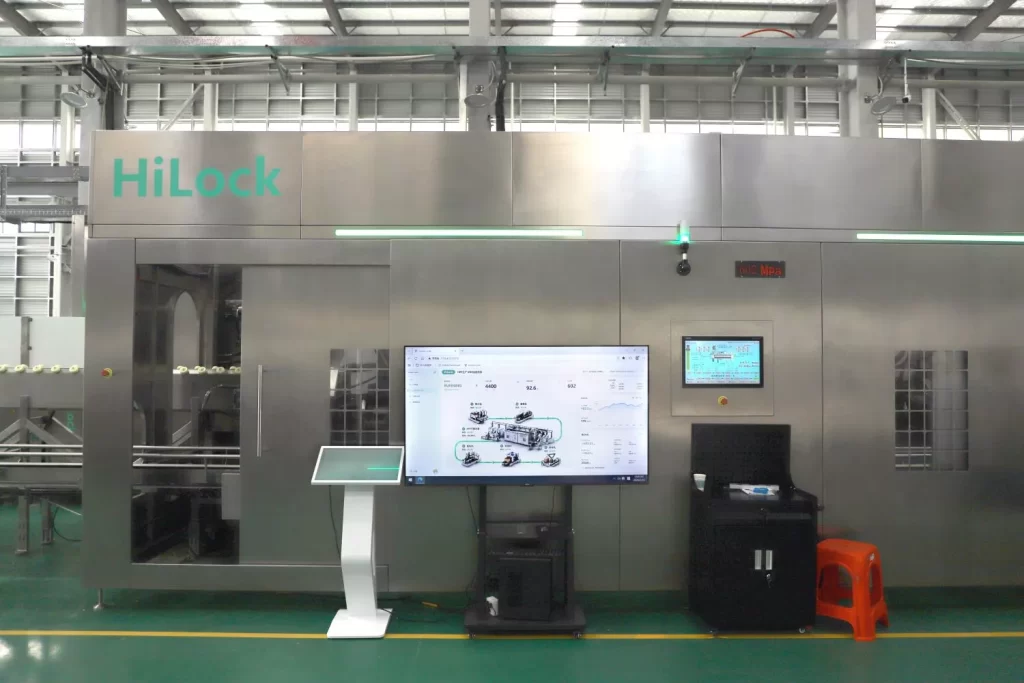
HiLock specializes in the R&D, design, and manufacturing of high pressure equipment and integrated HPP processing solutions.
Our high pressure cold sterilization equipment portfolio covers laboratory, pilot, and industrial production applications, enabling manufacturers to evaluate formulations before moving toward commercial-scale production.
The current product range includes 2 L laboratory systems, 55 L pilot systems, and 100–525 L production-scale high pressure cold sterilization equipment, with processing pressures adjustable within the 300–600 MPa range.
For children’s calcium nutrition drinks, equipment selection can be optimized according to:
- Product formulation
- Processing volume
- Packaging format
- Target pressure
- Processing time
- Production capacity
- Temperature requirements
- Hygiene requirements
- Automation level
- Future production expansion
This flexible approach allows manufacturers to move from laboratory testing and process validation to pilot production and industrial manufacturing using a coordinated equipment platform.
More Than an HPP Machine: Integrated Processing Support
The development of a children’s calcium nutrition beverage involves much more than selecting an HPP machine.
HiLock provides integrated technical support covering the entire project lifecycle.
Process Development
Before commercial production, manufacturers can conduct sample testing and process verification to evaluate the suitability of HPP for a specific formulation.
Different combinations of pressure, holding time, temperature, packaging, and formulation conditions can be assessed during process development.
Equipment Customization
Different production lines have different requirements.
HiLock can provide customized equipment configurations based on production capacity, factory layout, product characteristics, automation requirements, and other project specifications.
Installation and Commissioning
High pressure cold sterilization equipment must be properly integrated into the production workflow.
HiLock supports equipment installation, commissioning, process optimization, and operator training to help customers establish a reliable production process.
Lifecycle Maintenance
Long-term equipment performance is equally important.
HiLock provides technical support, maintenance, troubleshooting, and core-component support throughout the high pressure cold sterilization equipment lifecycle.
From Formula Validation to Commercial Production
For children’s calcium nutrition drinks, a practical HPP development pathway can include four stages:
1. Laboratory Testing
Evaluate whether the product formulation is compatible with high pressure processing.
2. Process Optimization
Determine suitable pressure, temperature, holding time, packaging, and storage conditions.
3. Pilot Validation
Verify product quality, microbial control, packaging performance, and process repeatability at a larger scale.
4. Industrial Production
Implement a customized HPP system designed around production capacity, factory layout, automation, and future expansion.
This staged approach can reduce the risk of directly moving from laboratory formulation to large-scale production without sufficient process validation.
Conclusion
Children’s calcium nutrition drinks place high demands on microbial safety, nutritional quality, sensory characteristics, formulation stability, and shelf life.
High Pressure Processing (HPP) offers a promising non-thermal processing approach for suitable beverage formulations by using controlled ultra-high pressure instead of relying primarily on intensive heat.
With laboratory-to-industrial equipment, customized engineering, process development, installation, and lifecycle support, HiLock provides an integrated HPP solution for manufacturers exploring advanced cold sterilization technology.
Whether you are developing a new children’s nutritional beverage or upgrading an existing production process, HPP testing can help determine whether ultra-high pressure processing is suitable for your product and commercial objectives.
Explore HPP technology with HiLock and develop a smarter processing solution for next-generation nutritional beverages.