
Table of Contents
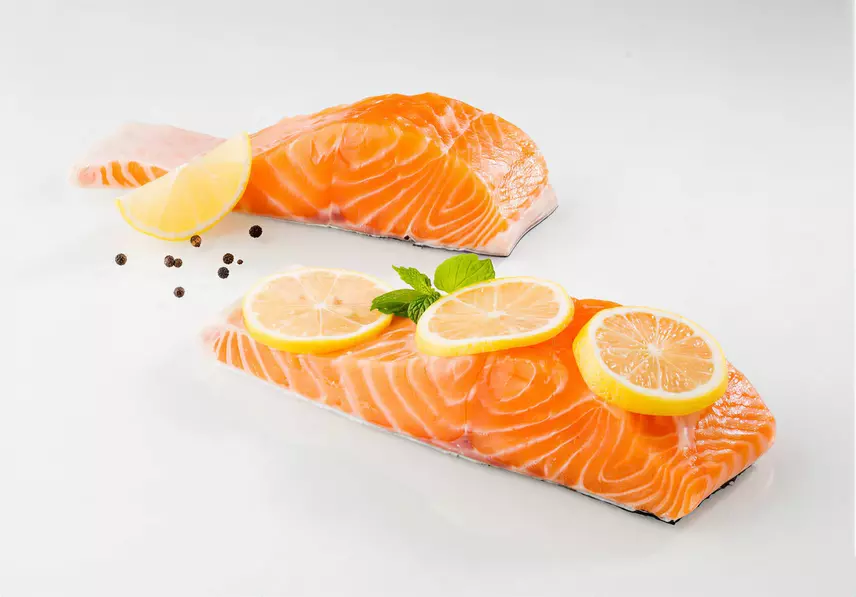
Salmon is valued for its fresh flavor, delicate texture, attractive color, high-quality protein, and beneficial fatty acids. However, these same characteristics make salmon highly perishable. Microbial growth, enzymatic activity, lipid oxidation, moisture loss, and temperature fluctuations during storage and transportation can quickly reduce product quality.
For salmon processors, the challenge is not simply to extend shelf life. The goal is to improve seafood sterilization and microbial safety while maintaining the fresh characteristics that consumers expect from premium seafood.
This is where High Pressure Processing (HPP) provides an alternative approach to conventional preservation technologies.
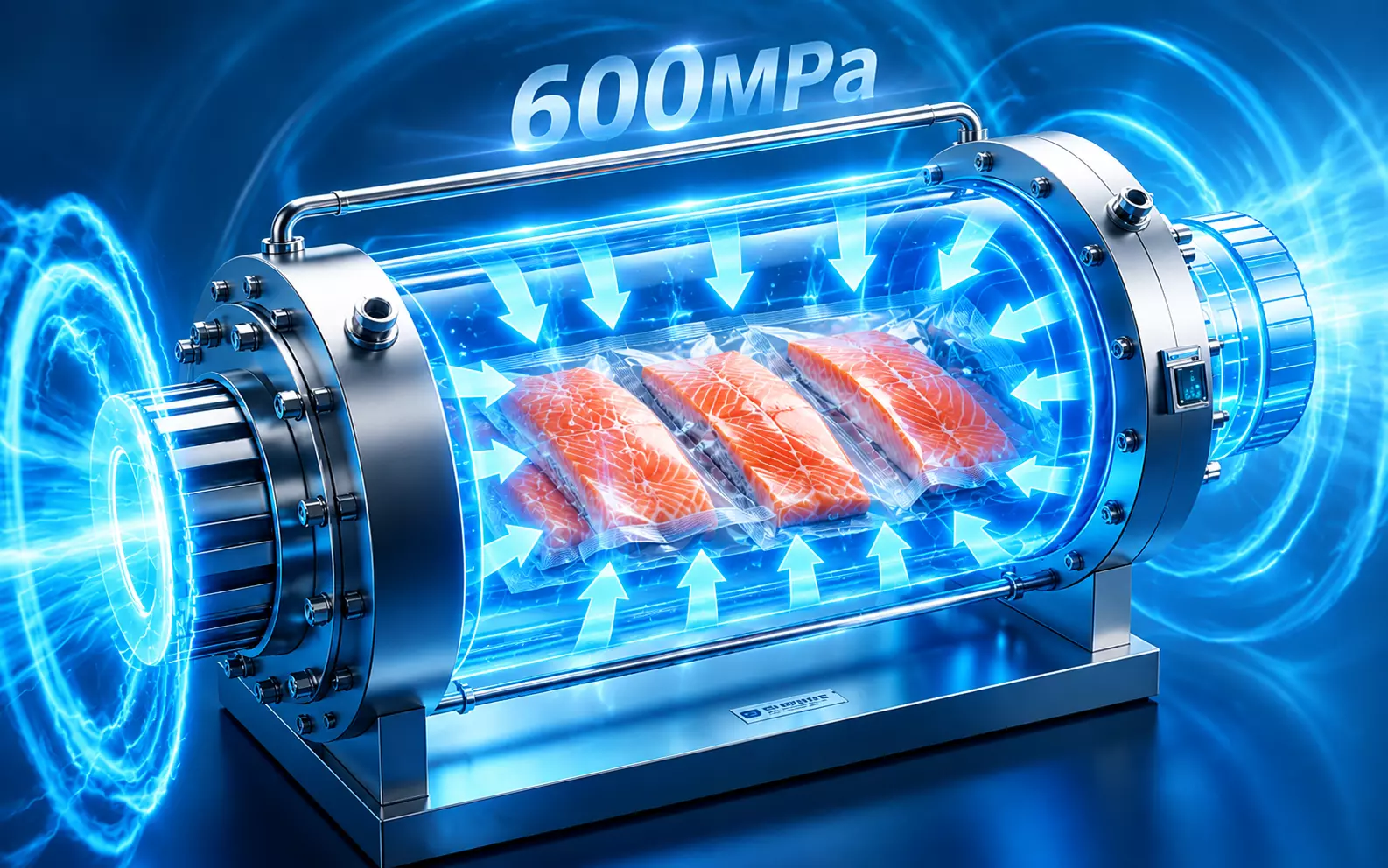
An HPP machine uses high hydrostatic pressure rather than conventional heat to process packaged food. When properly validated for a specific product, pressure can reduce vegetative microorganisms and extend refrigerated shelf life while helping preserve important sensory characteristics. Research on salmon and other seafood has demonstrated the potential of HPP for controlling microbial spoilage and extending shelf life, although the results depend strongly on pressure, holding time, temperature, species, packaging, and storage conditions.
For commercial salmon processors, therefore, HPP should not be viewed simply as a “sterilization machine.” It is better understood as a controlled preservation technology that integrates seafood safety, shelf-life management, quality preservation, packaging, and cold-chain requirements.
Why Is Salmon Difficult to Preserve?
Fresh salmon deteriorates through several mechanisms at the same time.
1. Microbial growth
Fresh fish contains high moisture and has a composition that supports microbial growth. During refrigerated storage, spoilage microorganisms can multiply and gradually produce undesirable odors, flavors, and other quality changes.
This makes microbial control one of the central objectives of modern seafood preservation.
Importantly, seafood preservation is not determined by microorganisms alone. Recent reviews identify microbial, enzymatic, and oxidative changes as major contributors to seafood spoilage, while storage temperature and packaging also have a significant influence on final shelf life.
2. Lipid oxidation
Salmon is a fatty fish containing unsaturated lipids. Oxidation can contribute to rancid flavors, undesirable odors, and nutritional changes during storage.
HPP can influence oxidation behavior differently depending on the fish species, pressure conditions, packaging system, and storage environment. Research on salmon, cod, and mackerel has shown that the effects of HPP on oxidation are not identical across species.
Therefore, an effective HPP process must be developed around the specific salmon product, rather than applying a universal pressure recipe.
3. Protein and texture changes
Pressure can affect proteins in fish muscle. At sufficiently high pressure, protein structures may partially or extensively change, potentially affecting hardness, water-holding capacity, pH, and color.
A review of high-pressure treatment of fish meat found that some of the most noticeable quality changes can occur in the 200–300 MPa range, with more intensive treatment potentially producing changes in protein structure, hardness, color, and water-holding behavior.
This creates an important engineering challenge:The objective is not to use the highest possible pressure. The objective is to identify the pressure-time-temperature combination that delivers the required microbial reduction while maintaining the desired salmon quality.
How Does HPP Support Seafood Sterilization?
The solution behind ultra-high pressure HPP equipment is remarkably clever. Instead of relying on heat or chemical additives, it uses physical high pressure to achieve microbial inactivation, freshness preservation, and quality retention.
First, the salmon is sealed in suitable packaging and placed inside the pressure vessel of the HPP system. The core ultra-high-pressure intensifier raises the pressure to 300-600 MPa, while ultra-high-pressure valves and an intelligent control system precisely regulate the pressure. The salmon is then subjected to high pressure for several minutes at near-ambient temperature.
This intense pressure can damage the cell membranes of harmful microorganisms and help inactivate certain parasites, while minimizing damage to the salmon’s muscle structure and nutritional components. As a result, the salmon can retain much of its original freshness, texture, and nutritional quality.
However, terminology matters. HPP is generally used for microbial reduction/pasteurization rather than commercial sterilization in the retort sense. Pressure resistance varies among microorganisms, and bacterial spores are considerably more resistant than vegetative cells. Consequently, the appropriate process target must be established through product-specific validation.
This distinction is especially important when developing commercial seafood processing protocols.
Why Use HPP for Salmon?
The biggest advantage of HPP for salmon is the possibility of combining microbial control and quality preservation within a non-thermal processing approach.
1. Extended refrigerated shelf life
Studies have demonstrated that HPP can extend the microbial shelf life of fish products under refrigerated storage. In one study involving fresh salmon, cod, and mackerel, HPP treatment affected microbial growth and shelf-life behavior, although the response varied by species.
A systematic review and meta-analysis published in 2023 also found that high-pressure treatment could extend microbial and sensory shelf life in different fish fillet and packaging combinations, with outcomes strongly dependent on processing conditions and fish type.
For salmon processors, longer validated shelf life can potentially provide greater flexibility for:
- Cold-chain transportation
- Regional and international distribution
- Inventory management
- Retail scheduling
- Food-service supply
- Premium chilled products
- Ready-to-eat seafood production
The exact shelf-life improvement, however, must be established through microbiological and sensory validation for the specific product.
2. Non-thermal processing
Traditional thermal processing can significantly alter the sensory characteristics of seafood.
HPP provides a different processing route because pressure can be applied without relying on high-temperature treatment as the primary preservation mechanism.
This is particularly relevant for products marketed around:
- Fresh taste
- Natural appearance
- Premium quality
- Minimal processing
- Clean-label positioning
HPP has consequently attracted attention as a non-thermal technology for seafood preservation and quality management.
3. Potential to preserve fresh sensory characteristics
Salmon consumers expect a specific combination of color, texture, flavor, and appearance.
HPP can help preserve these attributes compared with some conventional thermal approaches, but pressure itself can also modify fish proteins and therefore affect texture and color if processing conditions are too aggressive.
This is why HPP process optimization is essential.
The ideal process is a balance between:
Microbial Reduction + Shelf-Life Extension + Texture + Color + Flavor + Oxidative Stability
rather than simply maximizing pressure.
Can HPP Maintain Salmon Quality?
Yes, but the answer depends on the process conditions.
HPP has demonstrated potential for maintaining important quality characteristics in seafood, but pressure can also cause changes in fish muscle.
A review of fish-meat HPP research found that pressure can influence protein structure, hardness, water-holding capacity, color, and oxidation, particularly as treatment intensity increases.
This means that product development should evaluate at least four major quality indicators:
Color
Salmon’s characteristic appearance is one of its strongest consumer-quality signals. Excessive pressure can cause changes in appearance, making color measurement an important part of process validation.
Texture
Pressure-induced protein changes can affect firmness and texture.
Lipid oxidation
Because salmon contains significant amounts of unsaturated lipids, oxidation should be monitored during both processing development and storage testing.
Sensory quality
Instrumental measurements should ultimately be supported by sensory evaluation.
A successful HPP process should therefore demonstrate both microbiological effectiveness and acceptable consumer-facing quality.
HPP Pressure: Why Process Optimization Matters
One of the most common misconceptions about seafood HPP is that higher pressure automatically means better sterilization and better shelf life.
In practice, the relationship is more complicated.
HPP performance depends on multiple variables:
| Processing Factor | Potential Impact |
|---|---|
| Pressure | Determines the intensity of pressure treatment |
| Holding Time | Influences total treatment effect |
| Temperature | Affects microbial and quality responses |
| Product Composition | Influences pressure sensitivity |
| Packaging | Determines product integrity and process compatibility |
| Initial Microbial Load | Affects required microbial reduction |
| Storage Temperature | Strongly influences post-process shelf life |
| Fish Species | Determines pressure response |
| Fat Content | Can influence oxidation behavior |
| Product Geometry | Influences processing logistics and throughput |
Research on fish has demonstrated that different species can respond differently to the same pressure treatment. For example, a study evaluating salmon, cod, and mackerel at 200 and 500 MPa found distinct microbial and oxidation responses among the three fish species.
Therefore, seafood sterilization should always be treated as a validated process-development project rather than simply an equipment setting.
Choosing the Right HPP Machine for Salmon
Choosing an HPP machine should start with the production requirement rather than the equipment model.
1. Define the product
First determine what type of salmon will be processed:
- Fresh salmon fillets
- Vacuum-packed salmon
- Ready-to-eat salmon
- Smoked salmon
- Marinated salmon
- Salmon portions
- Salmon-based prepared foods
- Other seafood products
Different products may require different validation strategies.
2. Define the required throughput
Production capacity should be evaluated based on your target output, product characteristics, processing cycle, and daily operating requirements.
A laboratory HPP machine is ideal for product development, process optimization, and initial testing. A pilot-scale system helps bridge the gap between laboratory research and commercial production, allowing manufacturers to validate processing parameters and evaluate scalability.
For large-scale manufacturing, industrial HPP machines provide the capacity, automation, and operational efficiency needed to support consistent commercial production.
3. Evaluate pressure range
A higher maximum pressure provides greater process-development flexibility, but maximum pressure should not be the only selection criterion.
The more important question is: Can the equipment deliver the required pressure accurately, repeatedly, and economically for the target salmon product?
4. Consider packaging compatibility
HPP requires packaging that can tolerate substantial compression and recover after depressurization.
Flexible packaging formats are therefore commonly considered for HPP applications.
Packaging design should be evaluated together with:
- Material structure
- Seal strength
- Headspace
- Product geometry
- Compression behavior
- Post-process appearance
5. Consider automation and data management
For commercial seafood processing, automated control can improve process repeatability.
A suitable HPP machine should provide reliable monitoring of pressure, temperature, cycle time, and process records.
This becomes especially important when the equipment is integrated into a broader food-processing line.
Integrated High-Pressure Processing Solutions for Seafood
For commercial salmon producers, buying an HPP machine is only one part of the project.
A complete high-pressure processing solution may include:
Process development
Determine appropriate pressure, holding time, temperature, packaging, and storage conditions through product testing.
Equipment customization
Equipment capacity and configuration can be selected according to production volume, facility layout, product dimensions, and automation requirements.
Installation and commissioning
Industrial HPP systems need to be integrated with upstream packaging and downstream cold-chain operations.
Operator training
Personnel need to understand process parameters, equipment operation, safety procedures, cleaning, and routine maintenance.
Lifecycle maintenance
Reliable HPP production depends on inspection, preventive maintenance, replacement of wear components, and technical support throughout the equipment lifecycle.
For processors expanding from laboratory research to commercial seafood production, this integrated approach can significantly simplify technology transfer.
Conclusion
Salmon preservation requires a careful balance between food safety, shelf life, freshness, texture, color, flavor, and operational efficiency.
HPP provides a promising non-thermal approach to seafood preservation by applying controlled hydrostatic pressure to packaged products. For salmon processors, an appropriately developed HPP process can support microbial reduction and refrigerated shelf-life extension while avoiding the intensive thermal exposure associated with conventional heat processing.
However, successful seafood sterilization is not simply a matter of applying maximum pressure. The most effective strategy combines validated processing parameters, suitable packaging, reliable HPP equipment, cold-chain management, and product-specific quality testing.
For businesses evaluating an HPP machine or developing complete high-pressure processing solutions for salmon and other seafood products, the most important step is to start with the desired product and processing outcome, then build the equipment and process around those requirements.
This approach transforms HPP from a standalone piece of equipment into a scalable technology platform for modern seafood processing.