
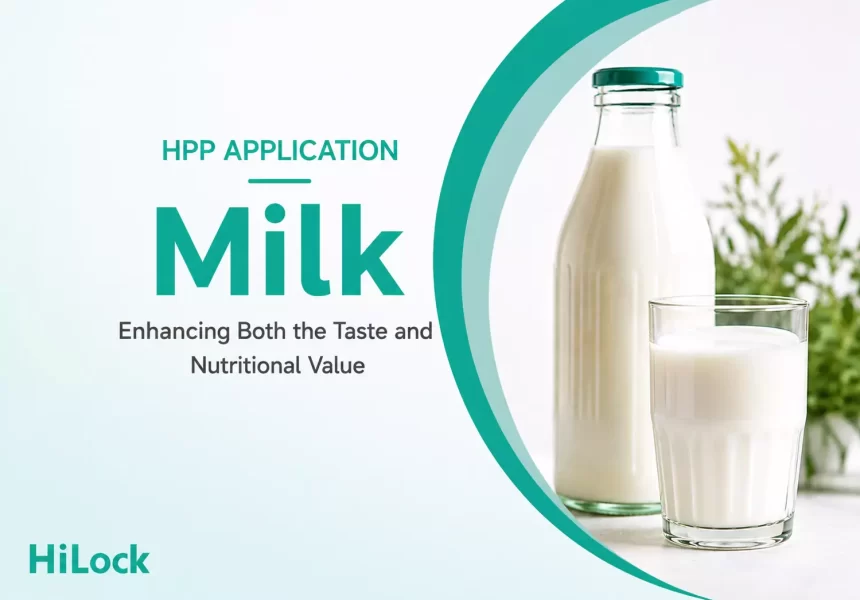
Milk is a widely consumed and nutrient-rich food, providing high-quality protein, calcium, vitamins, and a naturally rich flavor. However, when consumed without processing, milk may carry certain biological hazards. Historically, outbreaks associated with pathogens such as Listeria, Salmonella, Campylobacter, and Escherichia coli (E. coli) have raised significant food safety concerns.
Traditionally, milk processing—particularly pasteurization and sterilization—has relied primarily on heat to control microorganisms. Although thermal processing is highly effective for microbial inactivation, intensive heat treatment can affect milk’s natural flavor, nutritional components, and functional properties. As a result, emerging non-thermal sterilization technologies are receiving increasing attention.
Among these technologies, high pressure processing (HPP) is considered a promising approach that offers an alternative method of preservation. HPP primarily uses extremely high hydrostatic pressure rather than relying solely on high temperatures. It can help reduce microbial risks while better preserving the original sensory and nutritional characteristics of milk. Under refrigerated conditions, HPP can also extend shelf life by several times.
For dairy manufacturers seeking to develop high-quality, minimally processed products, high pressure processing equipment can help improve milk quality, extend refrigerated shelf life, and create new opportunities for product development.
Why Does Milk Processing Need a High Pressure Processing Equipment
Traditional milk processing has played a fundamental role in food safety for decades. Pasteurization effectively controls many pathogenic microorganisms and enables safe distribution of refrigerated milk.
However, heat can also influence some characteristics of milk.
Depending on the temperature and processing conditions, thermal treatment may:
- Alter milk’s fresh flavor
- Promote cooked or heated flavor notes
- Affect certain heat-sensitive nutrients
- Modify whey proteins
- Influence functional properties
- Reduce the perception of freshness
- Limit opportunities for minimally processed dairy products
These considerations are becoming increasingly important as consumers seek foods with cleaner labels, fresher sensory characteristics, and fewer unnecessary processing steps.
This is where HPP can complement conventional milk processing technologies.
How High Pressure Processing Equipment Works in Milk Processing
The basic HPP process is relatively straightforward.
1. Milk Preparation
Milk is first processed according to the product formulation and manufacturing requirements. Depending on the application, this may include standardization, filtration, homogenization, formulation, or other upstream processes.
2. Packaging
The milk or milk-based product is filled into a suitable flexible or semi-flexible package. The package must be capable of withstanding the pressure conditions used during HPP.
3. High-Pressure Treatment
The packaged product is loaded into the pressure vessel. Water is introduced into the vessel, and the high pressure processing equipment increases pressure to the required processing level.
Because pressure is transmitted uniformly through the water and product, the treatment does not depend on direct contact between the product and a heating surface.
4. Pressure Release
After the required pressure-holding time, the system rapidly depressurizes. The treated product is then removed and transferred to refrigerated storage or subsequent processing.
This pressure-based process can provide microbial control while minimizing the thermal exposure associated with conventional heat treatment.
How High Pressure Processing Equipment Helps Preserve the Flavor of Milk
One of the most attractive advantages of HPP in dairy applications is its potential to preserve the natural sensory characteristics of milk. Because HPP can avoid many of the flavor changes associated with thermal processing, it offers an alternative approach to conventional heat treatment. Sensory evaluations have shown relatively small differences between untreated and HPP-treated milk across multiple attributes, while participants generally preferred HPP-treated milk over pasteurized milk.
Consumers typically associate high-quality milk with a clean, fresh, and creamy taste. Intensive thermal processing, however, can result in cooked, sulfurous, or other undesirable flavor changes.
Because HPP primarily uses pressure rather than prolonged exposure to high temperatures, it can help maintain sensory characteristics that are closer to those of fresh milk.
For premium dairy brands, this creates an opportunity to position products around:
Fresh Flavor + Minimally Processed Positioning + Refrigerated Quality
Actual sensory outcomes depend on factors such as milk composition, packaging, pressure level, holding time, temperature, and target microorganisms. Therefore, HPP process development should always be validated for the specific dairy product.
High Pressure Processing Equipment and the Nutritional Value of Milk
The nutritional value of raw milk can be well preserved following high-pressure processing. Studies have reported that the levels of vitamins and minerals in HPP-treated milk can remain comparable to those in untreated milk, even after treatment at 6,000 bar (87,000 psi) for 10 minutes.
However, HPP should not simply be promoted as a technology that automatically preserves all nutrients. Nutrient retention depends on the specific nutrient, processing parameters, raw materials, storage conditions, and overall production process.
It is also important to note that vitamin stability remains affected by storage conditions. Some vitamins, including vitamins A, B3, B5, B6, and C, may gradually decline during refrigerated storage, although certain nutrients may degrade more rapidly in untreated raw milk.
For dairy manufacturers, a more accurate value proposition is that HPP can provide microbial control while reducing the impact of thermal processing, creating favorable conditions for maintaining the nutritional and sensory qualities consumers expect from milk.
Potential of High Pressure Processing Equipment for Pathogen Inactivation and Food Safety
As an effective non-thermal preservation technology, HPP can help inactivate common foodborne pathogens in milk, including Salmonella, Listeria, and norovirus, when appropriate pressure and processing conditions are applied.
However, one common limitation in existing studies is that pathogen survival during subsequent storage is not always monitored. In addition to improving food safety, HPP can also help reduce spoilage microorganisms in milk.
For example, treatment at 550 MPa for 5 minutes has been shown to effectively reduce the total viable microbial count. Following HPP treatment, bacterial growth during refrigerated storage can also be slowed, potentially extending the shelf life of milk to up to 21 days, depending on the product and validated processing and storage conditions.

HPP vs. Conventional Thermal Milk Processing
HPP and thermal processing use fundamentally different mechanisms.
| Feature | Conventional Thermal Processing | HPP |
|---|---|---|
| Primary preservation mechanism | Heat | High hydrostatic pressure |
| Product exposure | Elevated temperature | High pressure |
| Sensory preservation | Can be affected by heat intensity | Generally favorable for fresh sensory characteristics |
| Nutrient preservation | Depends strongly on thermal conditions | Can reduce thermal impact |
| Packaging | Usually compatible with conventional packaging formats | Requires pressure-compatible packaging |
| Processing approach | Heat-based | Non-thermal pressure-based |
| Product positioning | Conventional pasteurized/sterilized products | Fresh, minimally processed positioning |
| Refrigeration | Often required depending on process | Commonly required for HPP dairy products |
HPP does not necessarily replace every conventional milk processing method. Instead, it provides dairy manufacturers with an additional processing platform that can be integrated into a broader production strategy.
Designing High Pressure Processing Equipment for Dairy Applications
A high-performance HPP system must do more than generate high pressure. It needs to provide reliable pressure control, process consistency, safety, maintainability, and scalability.
For dairy applications, key equipment considerations include:
Pressure Capability
The system should provide a pressure range appropriate for the target application and validated microbial reduction requirements.
Pressure Uniformity
Uniform pressure transmission is fundamental to HPP. The equipment should maintain stable and repeatable pressure throughout the treatment cycle.
High-Pressure Vessel Design
The pressure vessel is one of the most critical components of an HPP system. Material selection, structural design, fatigue resistance, safety protection, and manufacturing precision all directly influence equipment reliability.
Intelligent Process Control
Modern systems can integrate automated pressure regulation, recipe management, process monitoring, alarms, and data recording to improve production consistency and traceability.
Production Capacity
Equipment capacity should be matched with product throughput, packaging format, batch size, cycle time, and production targets.
Sanitary Design
For food and dairy applications, hygienic construction and appropriate material selection are essential. Equipment configuration may also be customized to meet applicable food manufacturing and sanitation requirements.
From Laboratory Development to Industrial Production
One of the major challenges in HPP adoption is scaling a successful laboratory process to commercial production.
A professional HPP supplier should therefore provide more than a machine.
A complete solution can include:
Laboratory testing → Process development → Pilot validation → Equipment customization → Installation → Production commissioning → Lifecycle maintenance
This integrated approach allows manufacturers to evaluate product performance before making a large-scale equipment investment.
For milk processors, process development can include evaluating microbial inactivation, sensory quality, nutritional characteristics, packaging performance, refrigerated storage stability, and production economics.
The Future of HPP in Dairy
The dairy industry is increasingly exploring technologies that balance food safety, product quality, processing efficiency, and consumer demand for fresh-tasting products.
HPP fits into this trend because it offers a different way to approach preservation: using pressure as a primary processing force rather than relying solely on heat.
As HPP technology continues to develop, opportunities may extend beyond conventional milk to include:
- High-protein milk beverages
- Flavored milk
- Plant-based milk alternatives
- Dairy-based functional beverages
- Yogurt and fermented dairy products
- Cream-based products
- Nutritional beverages
- Premium refrigerated dairy products
For manufacturers seeking differentiation in increasingly competitive dairy markets, HPP can provide a technological foundation for developing products positioned around freshness, quality, and minimally processed characteristics.
Conclusion
High pressure processing equipment is opening new possibilities for modern milk processing by using high hydrostatic pressure to achieve microbial control while limiting the thermal impact associated with conventional processing.
For milk manufacturers, the potential benefits go beyond preservation. Properly developed HPP processes can help maintain fresh sensory characteristics, protect the quality of pressure-sensitive product components, support premium product positioning, and create new opportunities for refrigerated dairy products.
However, successful HPP implementation requires more than selecting a machine with a high pressure rating. Product formulation, packaging, microbial targets, processing parameters, validation, production capacity, and lifecycle support all need to be considered together.
With integrated equipment manufacturing, process development, customization, installation, and lifecycle services, HiLock provides a complete platform for manufacturers exploring HPP applications in milk and other food and beverage products.
For dairy companies looking to explore HPP milk processing, the right combination of high pressure processing equipment, process engineering, and application expertise can turn laboratory concepts into scalable commercial solutions.