
Table of Contents
As consumer demand for fresh, minimally processed, and clean-label food products continues to grow, manufacturers are increasingly adopting High Pressure Processing (HPP) technology to improve food safety while preserving product quality. From cold-pressed juices and ready-to-eat meals to seafood, meat products, and plant-based beverages, HPP has become an important processing technology for modern food production.
However, investing in an industrial HPP machine involves more than selecting a pressure rating or vessel size. Production capacity directly affects manufacturing efficiency, equipment utilization, operating costs, and long-term return on investment (ROI).
For businesses planning to expand their production lines, two common equipment capacities worth considering are 300L and 525L-class HPP systems.
But which one is right for your operation?
A 300L system may provide sufficient capacity for growing food manufacturers and established regional brands, while a 525L-class system may better support high-volume production, large-scale contract processing, and manufacturers with ambitious expansion plans.
This guide compares 300L and 525L-class HPP machines from the perspectives of production capacity, equipment configuration, operational efficiency, investment considerations, and application requirements to help you make an informed purchasing decision.
Understanding the Role of HPP Machine Capacity in Industrial Food Processing
Before comparing different equipment models, it is important to understand what HPP capacity actually means.
High Pressure Processing is a non-thermal food preservation technology that uses extremely high hydrostatic pressure, typically within the range of 300–600 MPa, to inactivate many foodborne pathogens and spoilage microorganisms.
Products are placed inside flexible, water-resistant packaging and loaded into a high-pressure vessel filled with water. Pressure is transmitted uniformly throughout the product, helping preserve its original taste, texture, color, and nutritional characteristics without relying on conventional high-temperature sterilization.
In industrial applications, HPP equipment capacity is generally expressed in liters (L), referring to the nominal volume of the pressure vessel.
For example:
- 300L HPP machine: Designed for medium-to-large production requirements, offering a balance between processing capacity and investment.
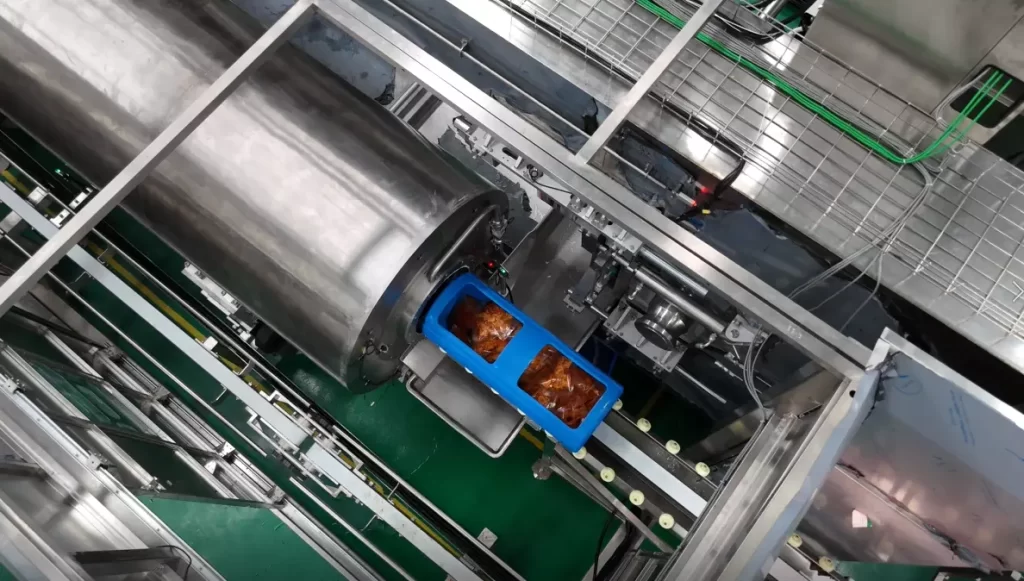
- 525L-class HPP machine: Designed for higher-volume manufacturing, providing greater vessel capacity and potential throughput per processing cycle.
However, a larger vessel does not automatically guarantee proportionally higher daily production.
Actual output depends on several factors:
- Effective loading volume and basket dimensions.
- Product packaging size and arrangement.
- Processing pressure and holding time.
- Loading, unloading, and pressure cycling time.
- Number of operating hours per day.
- Equipment configuration and booster performance.
Therefore, when comparing an HPP machine, manufacturers should evaluate actual daily output rather than relying exclusively on nominal vessel capacity.
300L vs 525L HPP Machine: Key Specifications and Differences
The most noticeable difference between 300L and 525L-class HPP equipment is processing volume. However, the distinction extends to equipment configuration, production efficiency, and the types of manufacturing operations each system is designed to support.
The following comparison uses representative HiLock industrial configurations, including a 300L HPP system and a 525L flagship HPP system as the 525L-class reference.
Technical Specification Comparison
| Specification | 300L HPP Machine | 525L-Class HPP Machine |
|---|---|---|
| Nominal vessel capacity | 300L | 525L |
| Maximum operating pressure | Up to 600 MPa | Up to 600 MPa |
| Booster configuration | 6 boosters | 12 boosters |
| Total power | Model-dependent | Approximately 550 kW |
| Daily production capacity | Approximately 13,000 L | Approximately 25,000 L |
| Operating schedule | Up to 24 hours/day | Up to 24 hours/day |
| Typical applications | Medium-to-large food production | High-volume industrial production |
| Main advantage | Balanced capacity and investment | Higher production throughput |
Production Capacity: 300L vs 525L-Class
Production capacity is often the first consideration when selecting an industrial HPP machine.
A representative 300L HiLock HPP system can achieve approximately 13,000 liters of daily production under its specified 24-hour operating configuration.
For manufacturers with relatively stable production demand, this capacity can support commercial-scale processing without requiring the investment associated with a larger system.
By comparison, the HiLock 525L flagship configuration is designed for significantly higher production requirements, with an estimated daily output of approximately 25,000 liters.
This provides greater processing capacity for manufacturers supplying national retail networks, large food brands, and industrial distribution channels.
Daily production comparison:
- 300L system: Approximately 13,000 L/day.
- 525L system: Approximately 25,000 L/day.
- Additional daily capacity: Approximately 12,000 L.
- Production capacity increase: Approximately 92%.
The larger system offers nearly twice the daily output of the representative 300L configuration.
However, this difference should be evaluated against actual market demand. Purchasing additional capacity without sufficient production orders may increase capital and operating costs without generating corresponding revenue.
Equipment Configuration and Power Requirements
Another important difference lies in the mechanical configuration.
A high-capacity HPP machine requires a coordinated hydraulic system to generate, maintain, and release extremely high pressure throughout repeated processing cycles.
The HiLock 300L system uses a six-booster configuration, while its 525L flagship model incorporates 12 boosters and approximately 550 kW of total power.
The multi-booster configuration is designed to support the pressure requirements and operating demands of large-volume industrial processing.
When evaluating different high pressure processing equipment manufacturers, buyers should pay particular attention to:
- High-pressure pump and booster configuration.
- Pressure vessel structural design.
- Pressure control accuracy and stability.
- Sealing systems and high-pressure connections.
- Cooling and temperature management.
- Automated loading and unloading compatibility.
- Control systems and operational monitoring.
These factors influence not only processing efficiency but also equipment reliability, maintenance requirements, and long-term operating costs.
Which HPP Machine Is Better for Your Production Requirements?
There is no universally optimal HPP capacity. The right equipment depends on your current production volume, product portfolio, business model, and future expansion plans.
When Should You Choose a 300L HPP Machine?
A 300L HPP machine is generally suitable for food manufacturers that have established commercial demand but do not yet require the throughput of a large industrial system.
It offers a practical balance between processing capacity, production flexibility, and initial investment.
Typical applications include:
1. Growing Food and Beverage Manufacturers
Businesses producing cold-pressed juices, fresh beverages, dips, sauces, and ready-to-eat foods can benefit from a 300L system when transitioning from small-scale production to commercial manufacturing.
2. Regional Food Brands
Regional manufacturers supplying supermarkets, restaurants, catering companies, and local distribution networks may find a 300L machine sufficient for their existing order volumes.
3. Contract HPP Processing Companies
Third-party HPP service providers often handle multiple products from different customers. A 300L system can provide a useful production platform while maintaining flexibility for different product batches.
4. Manufacturers Expanding Their Product Portfolio
Companies introducing new HPP-treated products may prefer a medium-to-large capacity system to validate market demand before committing to a larger production line.
Key advantages of a 300L system:
- Lower initial investment compared with a larger-capacity system.
- Suitable capacity for growing commercial operations.
- Greater flexibility for different product categories and production batches.
- Easier integration into existing production facilities, subject to site requirements.
- A practical starting point for manufacturers entering industrial HPP processing.
A 300L system is particularly attractive when production demand is growing steadily but has not yet reached the level required to justify a larger installation.
When Should You Choose a 525L-Class HPP Machine?
A 525L-class HPP machine is more appropriate for manufacturers with substantial production demand and a need to maximize industrial processing throughput.
For companies operating multiple production lines or supplying large distribution networks, greater processing capacity can help reduce production bottlenecks and improve overall manufacturing efficiency.
Typical applications include:
1. Large Food and Beverage Manufacturers
Companies producing high volumes of juices, smoothies, coconut water, and other packaged beverages may require larger vessel capacities to meet daily order requirements.
2. National and International Food Brands
Manufacturers supplying supermarkets, restaurant chains, and international distributors often need reliable production capacity to maintain consistent supply.
3. Large-Scale Contract Processing Facilities
Commercial HPP service providers processing products for multiple brands can benefit from higher throughput and more efficient utilization of production facilities.
4. Manufacturers Planning Long-Term Expansion
Businesses anticipating significant growth in production demand may prefer to invest in a larger system from the beginning rather than repeatedly upgrading their processing capacity.
Key advantages of a 525L-class system:
- Higher daily processing capacity.
- Greater output potential for large production orders.
- Better suitability for high-volume industrial operations.
- More room to accommodate increasing market demand.
- Potentially lower equipment-related costs per processed unit when operating at high utilization.
Nevertheless, a larger HPP machine also requires careful consideration of electrical infrastructure, factory layout, installation conditions, water systems, and overall production planning.
Quick Selection Guide
| Business Situation | Recommended Capacity |
|---|---|
| Entering commercial HPP processing | 300L |
| Regional food and beverage production | 300L |
| Medium-scale contract processing | 300L |
| Large-scale juice and beverage production | 525L-class |
| National retail distribution | 525L-class |
| High-volume industrial HPP services | 525L-class |
| Rapidly expanding manufacturing operations | 525L-class |
These are general recommendations. The final equipment selection should be based on actual production forecasts and process validation.
How to Calculate the Production Capacity You Actually Need
One of the most common mistakes when purchasing HPP equipment is selecting a model based only on current production volume.
Instead, manufacturers should calculate their required processing capacity based on expected demand, operating schedules, and production efficiency.
Estimate Your Daily Processing Requirements
Start by identifying your average daily production volume.
For example:
A beverage manufacturer produces 8,000 liters of packaged juice per day and plans to increase output to 12,000 liters within the next two years.
A representative 300L HPP system with an estimated capacity of 13,000 L/day may initially meet this requirement.
However, once production reaches 12,000 liters, the system will operate close to its nominal daily production capacity, leaving limited room for unexpected orders, product changes, or maintenance.
In this situation, a larger-capacity system may provide greater operational flexibility.
Consider Actual Processing Cycle Time
The complete HPP processing cycle generally includes:
- Product loading.
- Water filling and pressure preparation.
- Pressurization.
- Pressure holding.
- Depressurization.
- Product unloading.
The total cycle time directly affects the number of batches processed per hour.
A simplified production calculation is:
Daily Output = Effective Batch Loading Capacity × Processing Cycles per Hour × Operating Hours per Day × Loading Efficiency
For example, if an HPP system processes 525 liters per batch, completes four cycles per hour, and operates for 20 hours per day, its theoretical output would be:
525 × 4 × 20 = 41,920 liters/day.
However, this is only an illustrative calculation, not a guaranteed industrial production figure. Actual output must account for effective loading volume, product arrangement, processing parameters, and equipment availability.
For accurate equipment selection, ask manufacturers to provide validated production estimates based on your actual products and packaging specifications.
Plan for Future Production Growth
Equipment is a long-term capital investment. Therefore, manufacturers should consider not only current demand but also projected production growth over the next three to five years.
Consider the following questions:
- Will your production volume increase significantly?
- Are you planning to introduce additional product categories?
- Will you expand into new regional or international markets?
- Are you expecting to provide HPP contract processing services?
- Will your existing production facility support a larger system?
If production demand is expected to remain relatively stable, a 300L system may be the more economical option.
If substantial growth is anticipated, a 525L-class machine may reduce the need for premature equipment replacement or additional production lines.
Investment and ROI: Is a Larger HPP Machine More Cost-Effective?
Initial purchase price is important, but it should not be the only factor in evaluating HPP equipment.
A more useful approach is to compare the total cost of ownership (TCO) and potential return on investment (ROI).
Initial Equipment Investment
A 525L-class HPP machine generally requires a higher initial investment than a 300L system because of its larger pressure vessel, hydraulic configuration, power requirements, and supporting infrastructure.
However, the additional investment may be justified when production demand is sufficiently high.
The key is to determine whether the additional processing capacity can generate enough revenue to offset the higher capital expenditure.
Operating Costs
Operating costs should be evaluated based on the cost per liter or kilogram of processed product.
Important cost components include:
- Electricity consumption.
- Water consumption and circulation.
- Labor and production management.
- Preventive maintenance.
- Replacement seals and high-pressure components.
- Equipment downtime.
- Facility and supporting infrastructure.
A larger machine does not automatically mean lower processing costs.
For example, a 525L-class system operating at low utilization may have higher costs per processed unit than a fully utilized 300L system.
Conversely, when both systems operate close to their designed production capacity, the larger system may offer better labor efficiency and lower equipment-related costs per unit.
Production Efficiency and Revenue Potential
Higher production capacity creates an opportunity to process more products and serve more customers.
For contract processing businesses, additional capacity can support higher order volumes and potentially increase revenue.
For food manufacturers, it can help reduce production bottlenecks, improve supply reliability, and support expansion into larger distribution channels.
The following simplified framework can help compare the two options:
| Evaluation Factor | 300L System | 525L-Class System |
|---|---|---|
| Initial capital investment | Generally lower | Generally higher |
| Daily production potential | Moderate to high | Higher |
| Infrastructure requirements | Model-dependent | Generally greater |
| Labor efficiency at high output | Good | Potentially better |
| Expansion capacity | More limited | Greater |
| Best utilization scenario | Medium production demand | High production demand |
The most cost-effective HPP machine is not necessarily the largest one. It is the machine that matches your production demand while maintaining a sustainable utilization rate.
HiLock: Industrial HPP Equipment and Integrated Processing Solutions
As a specialized developer and manufacturer of ultra-high-pressure equipment, HiLock provides industrial HPP systems and integrated processing solutions for food, beverage, cosmetics, and biopharmaceutical applications.
Our capabilities extend beyond equipment manufacturing, covering precision machining, hydraulic system engineering, application development, and customized equipment integration.
Industrial HPP Equipment for Different Production Scales
HiLock offers multiple HPP equipment configurations to accommodate different manufacturing requirements.
300L HPP System
Designed for medium-to-large industrial production, the 300L configuration features six boosters and an estimated daily processing capacity of approximately 13,000 liters under its specified operating conditions.
It is suitable for manufacturers looking for a balance between production capacity and investment.
525L High-Capacity HPP System
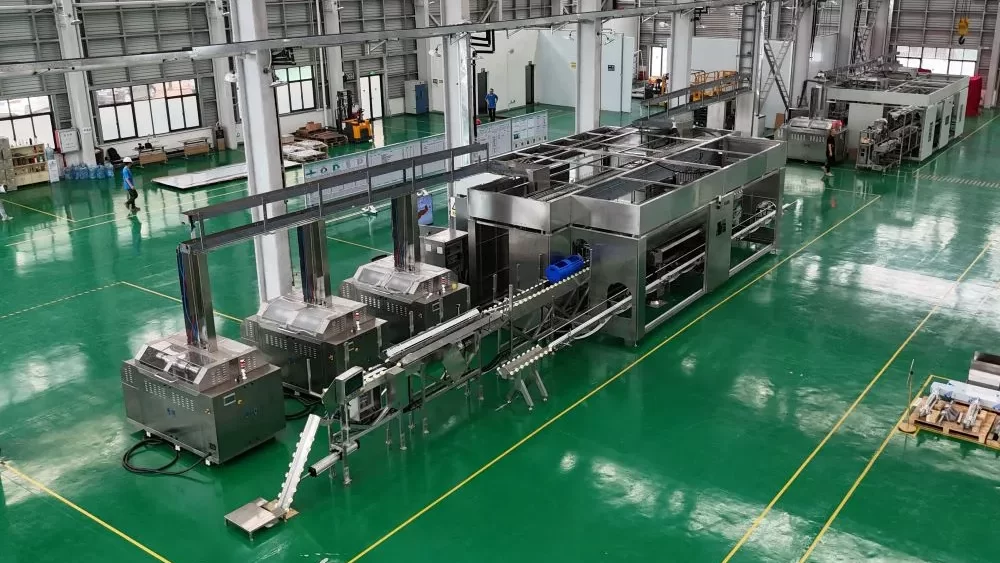
As HiLock’s flagship industrial configuration, the 525L system incorporates 12 boosters and approximately 550 kW of total power.
With an estimated daily processing capacity of approximately 25,000 liters, it is designed for high-volume industrial production and large-scale commercial processing.
The system is engineered for demanding industrial applications, with a pressure capability of up to 600 MPa.
Strong Engineering and Manufacturing Capabilities
HiLock combines multidisciplinary R&D expertise with modern production facilities, precision manufacturing processes, standardized quality control, and dedicated ultra-high-pressure testing capabilities.
Our engineering strengths include:
- Independent development of core high-pressure components.
- Precision machining and manufacturing.
- Stable supply chain management.
- Customized non-standard equipment solutions.
- Comprehensive equipment inspection and performance testing.
These capabilities support the development of reliable, application-oriented HPP systems for different industrial requirements.
Integrated Solutions from Testing to Installation
Selecting the right HPP machine requires an understanding of both the equipment and the product being processed.
HiLock provides integrated support throughout the project lifecycle, including:
- Application Testing: Evaluating customer products and packaging materials to establish suitable processing conditions.
- Process Development: Supporting pressure, holding time, temperature, and product quality validation.
- Equipment Selection: Recommending appropriate vessel capacities and system configurations based on production requirements.
- Customized Engineering: Developing equipment solutions tailored to factory layouts and manufacturing processes.
- Installation and Commissioning: Supporting equipment installation, system testing, and operational training.
- Lifecycle Maintenance: Providing technical support, maintenance guidance, and replacement components.
By combining equipment manufacturing with application expertise, HiLock aims to help food manufacturers improve processing efficiency, maintain product quality, and build sustainable production capabilities.
Conclusion: Choose HPP Capacity Based on Your Long-Term Production Strategy
Selecting between a 300L and a 525L-class HPP machine is ultimately a decision about production strategy, investment efficiency, and future business development.
A 300L HPP system is a practical choice for manufacturers with established but moderate production demand who prioritize investment control and operational flexibility.
A 525L-class system is more suitable for high-volume manufacturers, large-scale contract processors, and businesses planning substantial production expansion.
Before making a purchasing decision, evaluate your actual daily processing requirements, expected production growth, product characteristics, facility conditions, and total cost of ownership.
More importantly, work with an experienced manufacturer that understands both high-pressure engineering and real-world food processing applications.
HiLock provides industrial HPP equipment and customized high-pressure processing solutions, supporting manufacturers from initial product testing and equipment selection to installation, commissioning, and long-term technical service.
Whether you are planning to upgrade an existing production line or establish a new industrial HPP facility, our team can help identify an equipment configuration that matches your production goals.