
Table of Contents
The food processing industry has long faced a difficult trade-off: extending shelf life without compromising taste, texture, and nutritional quality. Conventional pasteurization and ultra-high-temperature (UHT) processing rely on heat to inactivate microorganisms, but excessive heat can alter fresh flavors, textures, and heat-sensitive nutrients. Meanwhile, consumers increasingly prefer clean-label products with fewer artificial additives and no added preservatives.
HPP Processing offers an alternative approach. By using extremely high hydrostatic pressure instead of conventional high-temperature treatment, HPP can improve food safety while helping preserve the original sensory qualities of many foods. It is increasingly used for premium juices, ready-to-eat meals, meat products, functional beverages, and selected baby food applications.
But how does HPP achieve these results without relying on high heat or added preservatives? And what makes it possible to extend refrigerated shelf life while retaining fresh quality? Drawing on practical experience in high-pressure technology, this article explores the core principles of HPP, the science behind freshness preservation, and its advantages for commercial food production.
Understanding HPP: A Physical, Non-Thermal Food Processing Technology
Conventional thermal processing uses heat to inactivate microorganisms by disrupting essential cellular structures and functions. Although effective, heat can also affect heat-sensitive nutrients, natural pigments, flavor compounds, and other quality attributes. Depending on the product and processing conditions, these changes may result in cooked flavors in juices, altered textures in meat products, or reduced levels of certain bioactive compounds in functional beverages.
HPP processing, also known as High Pressure Processing (HPP), uses hydrostatic pressure to inactivate susceptible microorganisms in packaged foods. Commercial systems commonly operate within a pressure range of approximately 400–600 MPa, depending on the application.
During HPP treatment, packaged food is placed inside a pressure vessel filled with water. High hydrostatic pressure is transmitted uniformly throughout the product, regardless of its shape or size. Because pressure is applied throughout the product rather than transferred through a heated surface, HPP can process packaged foods with minimal temperature increase compared with conventional thermal sterilization.
Although compression generates some heat, HPP processing is generally classified as a non-thermal or low-temperature processing technology because it does not rely primarily on high temperatures to achieve microbial inactivation.
Unlike thermal processing, HPP processing can help preserve many fresh sensory characteristics and heat-sensitive nutrients. However, its effectiveness depends on the food matrix, target microorganisms, pressure, holding time, temperature, and initial microbial load.
How HPP Works: Three Core Mechanisms Behind Food Preservation
The core principle of HPP processing is to use high hydrostatic pressure to alter the structure and function of microorganisms and certain food enzymes. When properly validated, this process can improve food safety and slow specific deterioration pathways.
Inactivating Microorganisms Through High Pressure
High hydrostatic pressure affects microbial cell membranes, membrane-associated proteins, and other essential cellular structures. These changes can interfere with membrane integrity, nutrient transport, enzyme function, and microbial metabolism, ultimately inactivating susceptible microorganisms.
HPP processing can reduce important foodborne pathogens, including Salmonella, pathogenic Escherichia coli, and Listeria monocytogenes, when suitable pressure, holding time, temperature, and product-specific conditions are established.
Because hydrostatic pressure is transmitted throughout the pressure medium and packaged food, it can reach microorganisms in different parts of the product without relying on direct heat transfer from the surface to the center.
However, HPP processing does not automatically achieve commercial sterility in every food. Bacterial spores can be highly pressure-resistant, and some microorganisms may survive depending on the processing conditions and food composition. HPP treatment must therefore be validated for the specific product and intended storage conditions.
Managing Enzyme Activity and Quality Deterioration
Microbial contamination is not the only cause of food quality deterioration. Endogenous enzymes can contribute to browning, oxidation, texture changes, and flavor degradation during storage.
HPP processing can inactivate or modify the activity of certain enzymes, depending on their structure and the processing conditions. This may help slow selected quality changes in foods such as fruit products, sauces, and prepared meals.
However, many food enzymes are relatively pressure-resistant. For example, some enzymes associated with fruit browning and quality degradation may retain substantial activity after conventional HPP treatment. The extent of enzyme inactivation depends on the enzyme, food matrix, pressure, temperature, and treatment duration.
For this reason, HPP processing conditions should be developed around the actual quality challenge rather than assuming that high pressure will completely deactivate all deterioration-related enzymes.
Preserving Fresh Flavor and Heat-Sensitive Nutrients
One of the major advantages of HPP processing is its ability to preserve many sensory and nutritional characteristics that can be affected by intensive heat treatment.
High pressure primarily affects molecular interactions and the structures of proteins, membranes, and other biological systems. Many small-molecule flavor compounds and nutrients, including certain vitamins and polyphenols, can remain relatively stable under suitable HPP conditions.
As a result, HPP-treated juices and other foods can retain more of their fresh flavor and color than products exposed to some conventional thermal treatments.
Nevertheless, nutrient retention is not identical across all products. Vitamins, pigments, flavor compounds, proteins, and bioactive ingredients respond differently to pressure and processing conditions. Actual retention rates should be determined through product-specific testing rather than assuming a universal percentage.
How Can HPP Processing Extend Shelf Life Without Added Preservatives?
Food manufacturers often ask how juices, prepared meals, functional beverages, and other products can achieve extended refrigerated shelf life without added preservatives or intensive heat treatment.
The answer lies in combining microbial inactivation with appropriate packaging, hygienic production, and a validated cold-chain strategy.
Reducing Microbial Loads After Packaging
HPP processing is commonly applied to food that has already been sealed in flexible, water-resistant packaging. This allows the packaged product to undergo high-pressure treatment after filling and sealing, helping reduce the risk of post-process contamination associated with certain downstream handling steps.
By reducing susceptible spoilage microorganisms and foodborne pathogens, HPP processing can help slow microbial spoilage and improve food safety when the process is appropriately validated.
Supporting Quality Retention During Refrigerated Storage
HPP processing can help extend refrigerated shelf life by reducing the viable population of susceptible microorganisms while preserving many fresh sensory characteristics.
However, shelf life depends on more than the treatment itself. Product acidity, formulation, initial microbial load, packaging integrity, storage temperature, surviving microorganisms, and enzyme activity all influence the final result.
For many HPP-treated foods, refrigeration remains essential. HPP processing should not be assumed to make every product shelf-stable at room temperature or eliminate the need for preservatives in every formulation.
Matching Processing Conditions to the Product
Different food categories require different pressure and holding-time combinations. Juice, fermented beverages, cooked meat, seafood, and prepared meals have different microbial risks and quality requirements.
HiLock HPP systems are designed to support controlled pressure processing, helping manufacturers develop suitable processing conditions for different food applications.
By evaluating pressure, holding time, temperature, packaging, and product characteristics together, food manufacturers can identify processing conditions that balance microbial safety, sensory quality, and refrigerated shelf life.
HPP vs. Traditional Food Preservation Methods
HPP, pasteurization, UHT processing, and chemical preservation work through different mechanisms. The most appropriate method depends on the product, target microorganisms, storage requirements, and desired sensory characteristics.
| Comparison | HPP Food Processing | Conventional Pasteurization | UHT Processing | Added Preservatives |
|---|---|---|---|---|
| Primary mechanism | High hydrostatic pressure | Controlled heat treatment | Intensive high-temperature treatment | Chemical inhibition of selected microorganisms or deterioration pathways |
| Product temperature | Usually relatively low, with some compression-related heating | Elevated temperature | Very high temperature for a short time | Depends on the formulation and other processing steps |
| Fresh flavor retention | Often favorable for suitable products | Depends on the time-temperature combination | Heat-related flavor changes may occur | Depends on the product and preservative system |
| Nutrient retention | Many heat-sensitive nutrients can be well retained | Depends on the nutrient and process | Some heat-sensitive nutrients may be reduced | Depends on the formulation and processing |
| Packaging | Commonly treated after sealing in pressure-resistant packaging | May be processed before or after packaging | Commonly combined with aseptic packaging | Depends on the product and production process |
| Shelf-life potential | Often supports extended refrigerated shelf life | Depends on the process and storage conditions | Can support extended ambient shelf life when combined with a validated commercial-sterility process and suitable packaging | Depends on the preservative, formulation, and storage conditions |
HPP vs. Pasteurization
Conventional pasteurization uses heat to reduce microbial hazards and extend shelf life. HPP uses hydrostatic pressure and can offer advantages in retaining fresh sensory characteristics in suitable foods.
Neither method is universally superior. The appropriate process depends on the target microorganisms, product composition, packaging, and required shelf life.
HPP vs. UHT Processing
UHT processing combines very high temperatures with a validated aseptic production and packaging system to produce commercially sterile products that can often be stored at ambient temperature.
HPP is more commonly used for products that benefit from fresh-like sensory characteristics and refrigerated distribution. Because conventional HPP does not reliably inactivate all bacterial spores, it should not automatically be treated as a replacement for UHT when ambient shelf stability is required.
HPP vs. Added Preservatives
HPP can help manufacturers develop products without added preservatives when the formulation, processing conditions, packaging, and storage strategy allow it.
This can support clean-label product development, although regulatory requirements and ingredient declarations depend on the market and product category. HPP does not eliminate the need for appropriate food safety controls or guarantee that every product can be formulated without preservatives.
HiLock HPP Technology: Supporting Commercial-Scale Food Processing
Backed by more than two decades of precision manufacturing experience at its parent company, Zhuhai CTT Technology Co., Ltd., HiLock focuses on high-pressure processing equipment and application-oriented engineering solutions.
HiLock’s capabilities include high-pressure equipment development, core component engineering, pressure control systems, and application process support. The company also offers production-scale systems, including the 525 L HPP machine, alongside high-pressure components and related technical services.
Beyond equipment supply, HiLock supports customers in evaluating and developing application-specific processing solutions.
Its food HPP laboratory can support sample testing, process parameter evaluation, production-line planning, scale-up, commissioning, and equipment maintenance. Depending on the food category and processing objective, testing can help assess pressure conditions, product quality, microbial reduction, and potential shelf-life improvements.
These services are particularly relevant for manufacturers addressing challenges such as flavor changes in fermented beverages, browning in juices, package swelling in prepared foods, and the retention of sensitive ingredients in functional beverages.
By combining equipment engineering with application testing and technical support, HiLock aims to help food manufacturers assess the feasibility of HPP, optimize processing conditions, and move toward reliable commercial production.
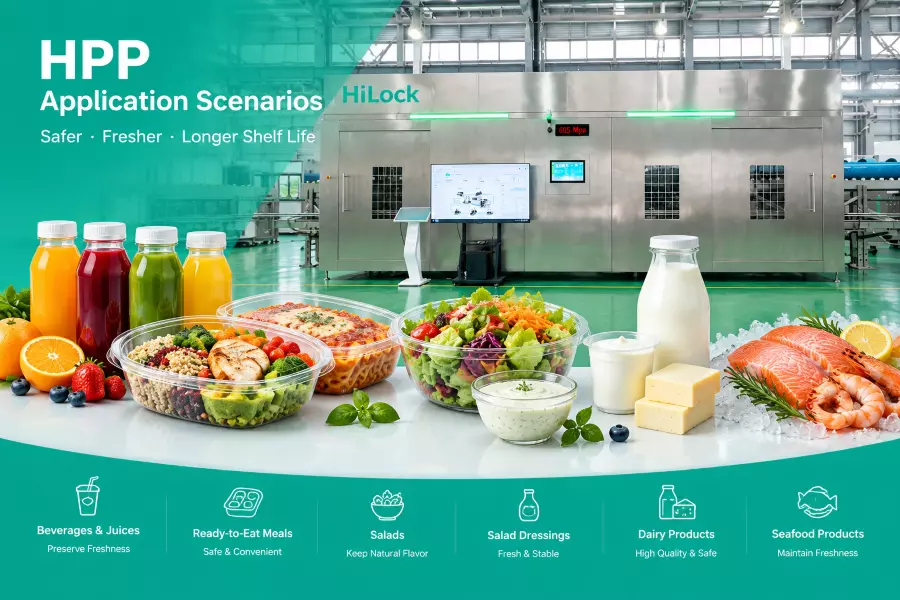
HPP Applications Across Premium Food Categories
HPP processing is used across a growing range of food categories where microbial safety, fresh quality, and refrigerated shelf life are important.HiLock HPP equipment has been used in various industries, including juice, dairy, meat processing, pharmaceuticals, and cosmetics, with its technical solutions validated across multiple sectors.
- Fresh juices and NFC beverages: HPP can reduce susceptible microorganisms while helping retain fresh fruit flavors and colors. Shelf-life improvements depend on formulation, processing conditions, packaging, and refrigeration.
- Fruit wines and fermented beverages: HPP may help control selected microorganisms and manage certain fermentation-related challenges. The effects on aroma, fermentation activity, and product stability require application-specific evaluation.
- Ready-to-eat meals: HPP can improve microbial safety and help extend refrigerated shelf life in suitable packaged products.
- Baby food and selected dairy products: HPP may be suitable for certain formulations, subject to specific microbiological validation, nutritional requirements, and applicable regulations.
- Meat and seafood products: HPP can reduce susceptible foodborne pathogens and spoilage microorganisms while helping preserve texture and fresh characteristics, depending on the product and treatment conditions.
- Herbal and functional beverages: HPP may help preserve selected heat-sensitive ingredients while improving microbial stability. The retention of individual active compounds must be verified through testing.
Conclusion: HPP Is More Than a Sterilization Method
HPP food processing offers a different approach to food preservation by using high hydrostatic pressure to reduce susceptible microorganisms while helping retain the fresh characteristics of many foods.
Its value lies in the combination of microbial control, sensory quality retention, packaging compatibility, and the potential to reduce reliance on added preservatives. However, successful implementation depends on product-specific process validation, appropriate packaging, hygienic production, and suitable storage conditions.
As demand for clean-label products and fresh-like food experiences continues to grow, HPP processing provides food manufacturers with another option for developing differentiated products and improving refrigerated shelf life.